

Semiconductor wars – identifying the likely winners

James Hayward, Global Equities Analyst at Flagship Asset Management
The $500 billion semiconductor business is commanding masses of investor attention because it is expected to double in size in the next seven years after taking more than 40 years to reach its current size.
But the share prices of the leading players in the sector have already run up significantly so where do the investment opportunities now lie?
Our preferred stock is Applied Materials, one of the largest of the equipment manufacturers that looks poised to capitalise on the industry’s strong growth prospects.
The main players.
There are three different segments at the bottom of the supply chain in the semiconductor industry. Integrated Device Manufacturers (IDM’s), such as Samsung and Intel, design and manufacture their own chips. Fabless players like AMD and Qualcomm only design chips. They outsource the fabrication of chips to Foundries, which are specialist companies, like TSMC.
Over the last 20 years, the number of players operating at the leading edge in each segment of the industry have dwindled down to a point where they can be counted on one hand. This is true for IDMs and foundries. Now a mere three companies are able to produce leading edge chips, namely TSMC, Samsung and Intel, compared to the roughly 25 companies in 2000.
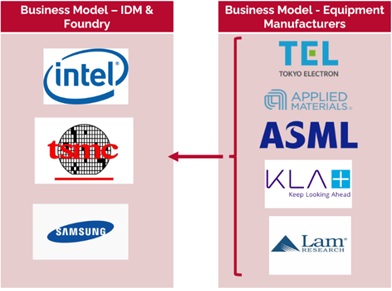
Further up the supply chain are the capital equipment manufacturers (semi caps), who make the individual components that IDMs and foundry players need to make chips. Similarly, the market share of the top five semi cap companies have increased from just over 50% to 70% over the past two decades. This is mostly due to the rapid pace of technological advancement and capital intensity required to stay competitive.
Identifying the potential winners.
The semiconductor industry seems to be at an inflection point, with a number of secular drivers determining the industry’s fortunes. These include the advent of the big data era, Artificial Intelligence, Autonomous driving, 5G, Internet of Things, which all require more, smarter, and faster semiconductors.
If the industry wants to keep up with Moore’s Law, it must keep evolving, creating more complex structures to decrease the size and power consumption of semiconductors. This is one of several drivers positioning the capital equipment providers more favourably compared to other segments over the coming years.
Reshoring of global supply chains is another factor that is bound to introduce inefficiencies into the system. TSMC, Intel, and Samsung are likely to be affected, as they might have to operate more factories at sub-optimal utilisation levels. The most likely benefactors will be companies tasked with kitting out these factories, namely the semicaps that will be churning out more equipment per unit produced.
Applied Materials our preferred semi-conductor chip
As a semicap player, Applied Materials sit further up the supply chain, which means they are generally more cyclical than IDMs and foundry players. Their share price has sold off to a greater extent during the cyclical downturn in semiconductors, even though there long -term prospects have not been impaired.
They have the broadest range of products and services within the industry, which provides them with valuable insight into the most pressing challenges faced by clients. An R&D budget of billions of dollars and a portfolio of more than 15 000 patents enables them to be a key player in solving some of the industry’s most difficult challenges. Lastly, their fortress balance sheet and high levels of free cash flow generation has enabled them to deliver good returns, while reducing the number of shares outstanding by 25% over the last five years.
Despite short-term headwinds., Applied Materials is well positioned to weather this and continue delivering strong returns to shareholders.


