

STANLIB: Ratings downgrade - Implication for investors

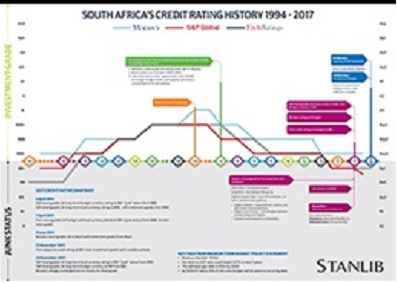
South Africa’s economic history since 1994 when the country first asked global ratings agencies to provide analysis can be seen in two phases. The first phase, from 1994 to 2012 was an 18-year period of systematic improvement, including among other things lower unemployment, strong foreign exchange reserves and controlled inflation.
Few economic indicators were deteriorating and this reflected in the country’s credit ratings that increased nine times across all the three ratings agencies to reach a peak of A3 in 2009.
In 2012, the country was downgraded for the first time in its history. And in the five years since, has been systematically downgraded nine times across all agencies, excluding the fourth quarter of this year.
 Click here to view a larger image
In a credit ratings review announcement on Thursday 23 November, Fitch held South Africa’s credit rating unchanged at BB+ (sub-investment grade) with a stable outlook.
Ratings reviews issued on Friday 24 November saw S&P downgrade South Africa SA’s local currency to BB+ (sub-investment grade) from BBB- (investment grade) and its foreign currency rating to BB, sub-investment grade, from BB+, also sub-investment grade.
Moody’s held South Africa’s credit rating unchanged at Baa3, still investment grade, but on review for a downgrade.
South Africa now fails to meet the requirements for inclusion in the Barclays Global Aggregate Index but retains its position in the Citibank World Government Bond Index (WGBI), of which it accounts for 0.45%.
How does SA’s credit rating downgrade affect STANLIB’s fixed income portfolios?
Leading up to Friday’s review announcement by both ratings agencies, the STANLIB Fixed Income team has been carefully analysing market movements and sentiment with the aim of identifying to what extent a credit downgrade was already priced into the market.
One of the key levers in our portfolios is how we are positioned on the interest rate curve. We have been cautiously invested on the short- to middle-end of the curve where yield expectations are more certain than on the longer end of the curve.
Within our portfolios, we have executed short-term opportunistic trades based on market mispricing and movements. By being readily armed with our views heading into the review announcements and executing our ideas quickly we have added to performance in the portfolios.
Our attention now turns towards the ANC elective conference and the potential for a sea-change in ANC leadership. Over the short-term, such a sea-change would be immensely positive for the country and bond yields.
Post the December ANC elective conference, we are turning our attention to the longer-term economic landscape. We are monitoring key indicators, including the State of the Nation Address on 9 February 2018. The finance minister’s budget speech due to take place on 21 February 2018 is another key indicator as it will give a clearer indication of how the country will fund its deficit and whether there is clear commitment to instilling growth policies to drive economic recovery.
These and other factors will be used to position the portfolio appropriately for the longer term using our core levers of duration, credit, the interest rate curve, and relative value.
What does the downgrade mean for ordinary South Africans?
Over the short-term, ordinary South Africans won’t feel the immediate impact of a credit downgrade, other than if the rand weakens. Over the longer term there will be a number of possible impacts including higher interest rates, higher inflation, currency weakness and additional budget constraints.
South Africa’s downgrade means that all future borrowing goes up. Government’s interest rate bill on debt goes up, which means more revenue spent on servicing debt and less revenue available for social security payments, healthcare, education, infrastructure protects etc.
To keep attracting foreign investors and in the absence of any credible growth plan, SA will need to keep interest rates attractive, meaning generally higher interest rates, which in itself will be negative for economic growth.
Any imported goods will become more expensive, including fuel, clothes and electronics. This means higher inflation, which will be an extra load on consumers who will primarily experience it through higher costs of living.
How does the downgrade affect the currency?
There are multiple factors that affect the exchange rate. Despite South Africa’s credit downgrade, foreign investors may still see value in the bond market. There are numerous global emerging market managers who are mandated to invest in emerging markets, including the likes of Brazil, which is two notches below junk status.
In this respect, the reaction from a downgrade could be surprisingly neutral. Global emerging market investors will be measuring SA bond yields relative to other emerging markets. And will be looking to determine whether the currency is going to weaken significantly. On a relative basis, the rand is already undervalued so some global investors may feel that the risk of significant further weakening is limited.
Henk Viljoen
Co-head STANLIB Fixed Income
Victor Mphaphuli
Co-head STANLIB Fixed Income
Copyright © STANLIB is a licensed financial services provider. A multi-specialist investment company across nine African countries. To find out more about our investment offering for retail, institutional and global investors, please visit our website: www.stanlib.com

