

One battle after another
The year started on an optimistic note for the local economy, with expectations of faster growth, lower inflation and falling interest rates.
The Government of National Unity (GNU) seemed to be settling in after a few challenges last year, while the February Budget was well-received by the market, showing a gradual improvement in South Africa’s fiscal position.
Since then, it has been one battle after another, to steal the title of this year’s big Oscar winner. The record increase in petrol and diesel prices has clouded growth and inflation while the political direction is also unsure following the Constitutional Court hearing on the “Phala Phala” matter. South Africa has also featured in the hantavirus story, but largely positively given the quality of medical care offered to the victims. There is no indication that this will turn into another global pandemic, but after 2020 everyone is on heightened alert. The past few days have seen storms batter the country, and a national disaster has been declared.
Legal earthquake
Let’s start with the Constitutional Court’s landmark ruling, delivered on the 30th anniversary of the adoption of the constitution. It determined that Parliament was wrong in December 2022 when it buried the Section 89 report on the dollars that were stolen from President Ramaphosa’s game farm three years prior. It ordered that the report be considered by an impeachment committee set up by the Speaker of Parliament. If this committee finds grounds for impeachment, which could take us into next year, a two-thirds vote in the National Assembly will be needed to remove the President. Although the ANC no longer holds a majority in Parliament, its 159 of 400 seats in the National Assembly would be enough to block an impeachment vote. It will also be interesting to see how the other GNU parties respond, especially in the lead-up to the November local government election. President Ramaphosa could still take the original Section 89 to court for judicial review, which means this matter could still drag on well into next year. His term of office as ANC president will end late 2027, while the 2029 general election is still far off.
Several scenarios now loom. One is that Ramaphosa fights back and uses the courts and other means to delay proceedings for as long as possible until his term runs out anyway. The second is that he chooses to resign, rather than be dragged through an unseemly process. This would propel Deputy President Paul Mashatile into the hot seat. A third possibility is that impeachment proceedings continue but ultimately fail to meet the two-thirds threshold. In each of these scenarios, there is also the possibility that some GNU partners decide to jump ship, and a new ruling coalition emerges.
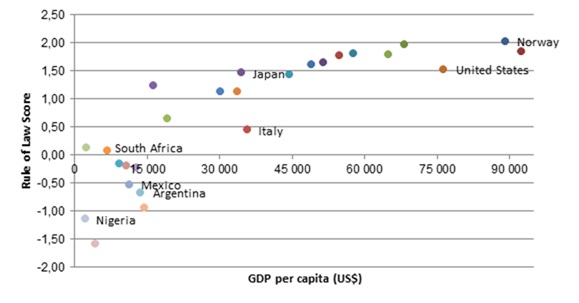
Chart 1: World Bank Rule of Law score against per capita income, selected countries
Source: LSEG Workspace
Markets don’t like political uncertainty in the short term. Over the longer term, however, rule of law matters more. It is crucial for economic development and well functional capital markets, and as chart 1 shows, it is strongly correlated with higher levels of national income. The fact that South Africa has an independent judiciary remains a major strength and the Constitutional Court has again demonstrated that it does its work without fear or favour. There are increasing doubts over whether one can say the same of the US Supreme Court, for instance. But in South Africa, the principle that no one is above the law still holds.
Policy, not politics
The main question for investors is about policy, not politics or personalities. None of the scenarios described above imply a dramatic shift away from the current policies aimed at fiscal consolidation, unbundling of state monopolies, fostering greater private investment in key network industries, and generally improving state capacity and lowering the cost of doing business.
There is a broad cross-party consensus that the country needs faster economic growth, and several key reforms have already been legislated. However, a new president or new coalition government could shift the emphasis in one way or another. Unfortunately, the crucial but uncompleted reforms needed to address corruption and underperformance of the police, as revealed by the Madlanga Commission, could be a victim of politics. This is the main reason why South Africa’s rule-of-law score isn’t higher.
Click here to read more...


