

Navigating Uncertainty: The South African Rand (ZAR) Outlook
The South African Rand (ZAR) is navigating a turbulent global financial landscape marked by significant uncertainty. As of 14 April 2025, the ZAR’s performance against major currencies reflects a mix of domestic vulnerabilities, which began with a delayed budget in February.
This was compounded by speculation regarding the tailwind (from an investor's perspective) of a fractious Government of National Unity (GNU) and the subsequent announcement of a new global tariff regime enacted by the US, without offsetting positive measures such as tax cuts and deregulation.
Market Volatility and Trade Disruptions
These developments have injected volatility into equity, bond, and currency markets, disrupting global trade systems and prompting negotiations to mitigate adverse impacts. For South Africa, a commodity-dependent economy, declining commodity prices and financial market turbulence present significant headwinds. This situation is exacerbated by the financial market volatility occurring at a time when the global economic cycle was beginning to soften. The derisking by global market players, driven by movements in equities, bonds, and currencies, could lead to long-lasting consequences.
These geoeconomic shifts are amplified by several factors: the European Union's increased spending in the defence sector, Germany's fiscal stimulus measures, China's struggle to address a debt deflation crisis stemming from its property market, and Japan's transition to a regime of higher interest rates. Together, these dynamics, along with US policy changes and global trade disruptions, contribute to a perceived decline in the USD's dominance and the broader implications of de-dollarisation. This creates a complex outlook for the ZAR, characterised by near-term weakness, potential for stabilisation, and considerable unpredictability. US tariffs, intended to enhance domestic competitiveness, may paradoxically weaken global demand and GDP growth, indirectly pressuring emerging market (EM) currencies like the ZAR.
Against the USD, the ZAR faces ongoing pressure, particularly given the South African government's foreign policy position, which, while stated as neutral, is perceived by many as antagonistic to US interests. The ZAR’s vulnerability to global risk aversion is well-known; often, its deep currency and derivative markets (by emerging market standards) mean that the ZAR acts as a proxy for broader global EM issues, not just those of its own making.
Recent Developments and Future Projections
However, the recent shifts in tariffs from the United States and an escalating tariff dispute—which may escalate into a trade war—highlight the structural challenges facing the USD. These include a growing US net international investment deficit exceeding 80% of GDP and reduced foreign capital inflows, which may temper the ZAR’s depreciation against the USD. Since the beginning of April, significant movements in global currencies have been observed, with the dollar weakening against the Euro, GBP, Yen, and CHF. The market appears to be reassessing the USD's status as the world’s reserve currency, driven by de-dollarisation trends and a perception of declining confidence in the US bond market. This USD weakness could support the ZAR, with projections suggesting a trading range of R18.44/USD to R20.00/USD, biased toward the lower end as the USD loses ground. It is noteworthy that the ZAR traded as low as 18.08 against the dollar in late March.
In response to these market conditions, we have transitioned from having no currency hedges in our portfolios to increasing currency hedges across all our multi-asset portfolios at the time of writing to mitigate risks associated with currency fluctuations.
Economic Fundamentals and Domestic Challenges
The ZAR’s performance against the EUR is similarly nuanced. The ZAR is undervalued by approximately 21% against the EUR based on purchasing power parity (PPP) models. The EUR’s strength, bolstered by potential fiscal space in Europe would suggest a much stronger Euro and hence upward pressure on EUR/ZAR. However, the shifting global landscape introduces uncertainty. Reserve currency alternatives like the EUR may face appreciation pressures, potentially prompting dovish responses from the European Central Bank (ECB), which could cap EUR gains against the ZAR.
The ZAR’s trajectory is less directly tied to de-dollarisation but still affected by global risk sentiment and South Africa’s economic fundamentals, which remain fragile amid concerns about the GNU and domestic growth prospects. The idiosyncrasies of the ZAR should be contextualised within a framework that presents a slightly more extreme picture than many other emerging markets and commodity producers:
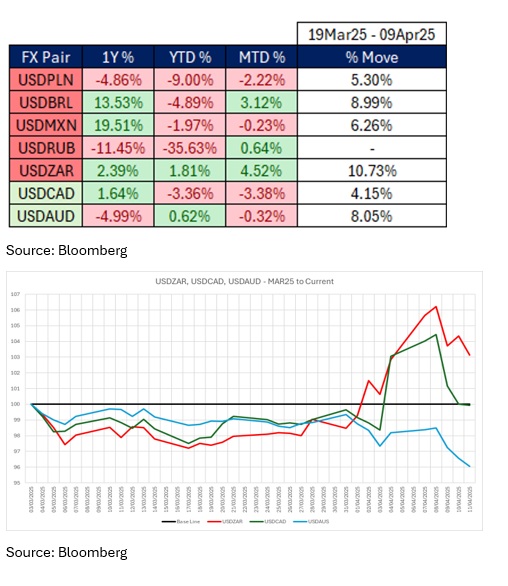
The weekend news regarding the reversal of VAT hikes within the budget is viewed as very positive. The sell-off in the ZAR, which has been more pronounced than in other emerging markets, may lead to some strength in the ZAR. This change in stance around VAT could be fiscally concerning (if no spending cuts are evidenced), yet it indicates a government with some checks and balances. Given the extreme short-term movements, this should lead to some gains in our currency and bond market.
Long-Term Outlook
Longer term, the broader theme of de-dollarisation adds a layer of unpredictability, presenting both risks and opportunities for the ZAR. A weaker USD may alleviate some depreciation pressure, but the ZAR’s exposure to global trade disruptions and its lack of insulation—unlike some Central and Eastern European currencies tied to the EUR, or frontier African currencies with limited trade linkages—leaves it vulnerable.
Looking ahead, the ZAR’s path remains uncertain due to the epochal shifts in the global financial architecture, which could lead to new equilibria in global finance, impacting the ZAR in unforeseen ways. For now, the ZAR is likely to remain range-bound against major currencies, with near-term weakness giving way to cautious stabilisation, contingent on global trade dynamics and South Africa’s ability to navigate domestic challenges.

