

An anniversary to forget

Dave Mohr, Chief Investment Strategist at Old Mutual Multi-Managers.

Izak Odendaal, Investment Strategist at Old Mutual Multi-Managers.
While South Africans commemorated Women’s Day, many investors had another anniversary on their minds. On 9 August, ten years ago,
French bank BNP Paribas grabbed headlines by freezing three investment funds after the market for sub-prime securities seized up. Although it wasn’t the first sub-prime domino to fall, this was in many ways the point at which the acute phase of the credit crunch started. It was the first sign of panic jumping from the American housing market to global financial capitals and forcing a response from the authorities (in the form of a liquidity injection from the European Central Bank). It would culminate in the collapse of Lehman Brothers and bailout of insurance giant AIG 13 months later, unleashing a global financial tsunami and deep recession.
At a time when investors are worried about North Korea and US President Trump’s “fire and fury” warning, it is worth remembering that the greatest financial crisis since the 1930s had its roots not in a geopolitical conflict, but in the steady build-up of economic imbalances, rising household debt, untested new financial products and a murky “shadow” banking system. The aftermath of that crisis is still felt today economically, politically and financially. We’ll consider these in turn.
Economic aftermath
Economies typically bounce back quickly from recessions, as consumers and businesses respond to low interest rates. However, because of the massive pre-crisis build-up of debt, this traditional mechanism of boosting demand mostly failed. Even record low interest rates could not tempt scarred borrowers, who instead focused on reducing debt. Banks have also tightened lending criteria in response to their near-death experience (and regulatory pressure). Therefore, while aggressive and innovative action by central banks (including quantitative easing) probably prevented a repeat of the 1930s Great Depression, monetary policy was not enough to lift growth.
One country that bucked the trend of deleveraging was China, where several waves of credit have been unleased since 2008 to stimulate growth whenever it looked at risk of falling below Beijing’s target. China now faces the tricky balancing act of reducing dependence on credit, shifting away from its old growth model towards services and consumption without a further slowdown in growth.
Politics and policy
Fiscal policy – how governments adjust tax levels and spending – would’ve been more effective. However, in both the US and Europe (where it was most needed) the political climate quickly headed in the opposite direction, and austerity measures were implemented. In the US, political deadlock resulted in a debt ceiling crisis in 2011 and a shutdown of the federal government in 2013. The debt ceiling (which authorises Treasury to borrow funds to pay for obligations) was raised routinely, but has now become a political football. It needs to be raised again within the next few weeks, failing which the federal government could technically default on some of its obligations.
In Europe, austerity, the Greek debt crisis and a premature interest rate hike by the European Central Bank (ECB) in 2011 resulted in a double-dip recession by 2012. The ECB was eventually forced to cut rates below zero. At the moment, the Eurozone economy is enjoying rather sprightly growth, and appears to finally be putting the lost decade behind it. However, growth is not evenly spread across countries. Germany is booming, but in Italy, where banks remained stuffed full of pre-crisis bad debts, national income has not returned to 2007 levels. Greece’s economy is much smaller than in 2004, when it hosted the Olympic Games.
A feature of the post-crisis era has been the widening wealth gap in developed countries, with wage growth stagnating for most workers, while the net worth of the top 1% is flourishing. One consequence has been the rise of anger politics and increased political uncertainty in general. Brexit and the election of Donald Trump have been the most high profile manifestations of this trend. France’s new President Macron, though very different to Trump and a darling of the markets, also ran as a complete outsider and sidelined France’s traditional parties. Another consequence of the lack of wage growth has been continued low interest rates. Central bankers in the US and Europe still largely operate on the assumption that falling unemployment will put upward pressure on wages and ultimately prices.
South Africa’s difficult decade
The post-crisis era in South Africa has been difficult. The initial rebound from the recession was brisk, aided by generous salary increases for public servants, a quick recovery in commodity prices, and of course the euphoria of hosting the 2010 World Cup. But from 2011 onwards, the economy took blows from all directions. Commodity prices slumped as it became clear China would not enjoy double-digit growth forever, the rand collapsed and Eskom was forced to implement load-shedding in 2014 and 2015. The Reserve Bank hiked rates from 2014 onwards. A massive drought resulted in a food price shock. Economic growth undershot expectations every year from 2012 onwards, and culminated in a technical recession. However, second quarter data from mining and manufacturing - together making up a fifth of the economy - suggests that the technical recession could be over already.
Of course domestic political uncertainty is elevated, weighing on business and consumer sentiment. While the President survived an eighth motion of no confidence in Parliament, his successor will be elected in December. And whoever becomes the new leader of the ANC, and thereafter South Africa, will face a weak economy, with 27% unemployment, and the challenge of stabilising government debt levels and reducing risks in State Owned Enterprises. Fortunately, the global backdrop remains favourable.
The search for yield
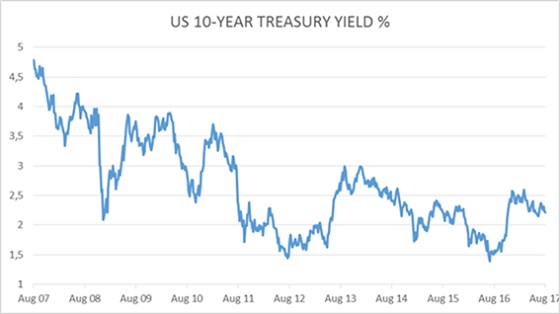
In the post-crisis era, the yield on the 10-year US Treasury (the benchmark global risk-free rate) declined from 3.9% to 2.2%, reflecting low inflation, low interest rates and an excess of savings. A consequence of low interest rates (and quantitative easing) in the developed world, in turn, has been a flood of capital chasing higher yields in emerging markets. So much so that the Brazilian finance minister complained of a currency war in 2010 as his real relentlessly appreciated, squeezing exporters. One should be careful what you wish for though: two years later the real (and other emerging market currencies, including the rand) were in freefall as the dollar surged in anticipation of much higher US interest rates. However, US rates have only increased by 1% and markets are pricing in only very gradual future increases. The dollar is in reverse, and emerging markets are once again in favour.
This helps explain why the rand has been volatile but range-bound this year despite all the political upheaval and consequent credit rating downgrades. Foreigners have been net buyers of almost R50 billion in government debt this year. Moody’s did not make its anticipated credit rating announcement on Friday, saying there had been no changes since the June downgrade.
Financial markets after the crash
Apart from the decline in interest rates, the relatively strong performance of equities (led by the US) is a feature of the post crisis era. The MSCI All Countries World Index, a broad measure of global share prices, briefly hit a new record level last week. Including dividends, this amounts to a 15% annualised gain since bottoming in 2009. (Over the whole ten-year period that includes the crash, returns are only 5% per annum.) At every step of this rally, investors and commentators (not always the same thing) wondered whether it was too much too soon, driven by the “sugar rush” of cheap money. Somewhat ironically, many commentators are also worried about subdued volatility on markets, fearing that it somehow reflects complacency.
Equity markets flirting with new highs should be normal since markets trend up over time. (We all break our own personal age records every single day.) This by itself is no reason for concern. The concern is that markets have raced ahead of earnings growth (though reported earnings growth is running in double digits this year after declining in 2016). The forward price to earnings (PE) ratio of the MSCI All Countries Index stands at 16, meaning investors are prepared to pay $16 for $1 of the next 12 months’ earnings. This has increased substantially from $10 in 2009.
In any event, PE ratios don’t tell us where the market is going next. It was not elevated prior to the 2008 crash. But it does give a good indication of longer-term returns, and these are likely to be somewhat below average from this starting point. Investors will therefore have to rely on smart asset allocation and stock picking to generate returns.
The South African equity market similarly pushed new record highs in recent weeks, and also trades at an elevated forward PE of 15. However, the JSE has fundamentally changed in the post crisis era and it no longer reflects the local economy (so much so that the Reserve Bank removed it from its index of leading economic indicators) but instead is dominated by global corporations.
Being prepared
Most bull markets die in a fog of euphoria, when the last proverbial fool cannot find an even greater one to sell to. This bull market remains mired in doubt and scepticism. Although a correction from lofty heights is possible (but impossible to time), another major bear market is unlikely while economic growth is steady, interest rates benign, inflation low and household deleveraging still underway. That said, the next crisis is always unlike the last, and the best preparation is to be appropriately diversified with a good understanding of the risk implications of each asset class you’re invested in.
Chart 1: The MSCI All Countries World Index total return and 12-month forward price earnings ratio
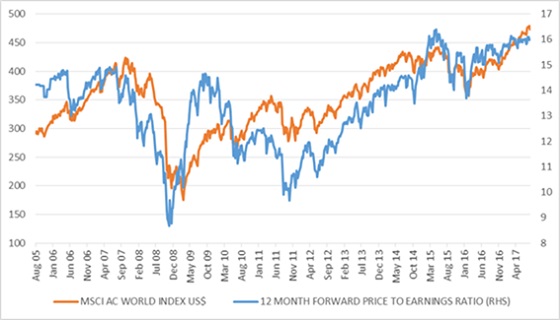
Chart 2: US 10-year government bond yield
Source: Datastream

