

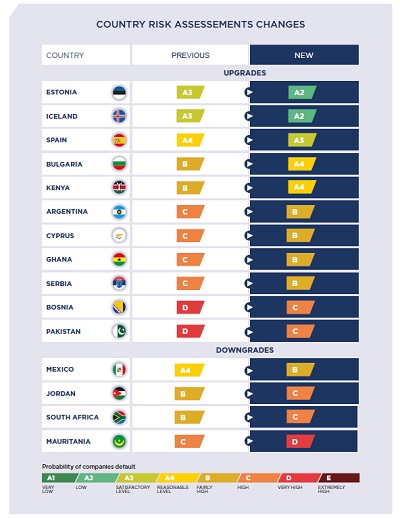
2017: Coface upgrades eleven countries and downgrades four
For the first time since mid-2015, Coface has made more upgrades than downgrades in its country risk assessments covering business credit risk: At the Coface annual country risks conference in Paris, Coface said that despite the recent economic upturn, uncertainties will continue to dominate global economic climate this year.
World trade under the threat of protectionism
Following two consecutive years of slower world growth, the outlook should improve marginally in 2017 (from 2.5% in 2016 to 2.7% in 2017). This will be driven by a rebound in business in emerging countries (4.1% growth) due to recoveries in Brazil and Russia offsetting the slowdown in China. Advanced countries will see stable growth of 1.6%.
The lacklustre development in world trade (forecast at +2.4% for 2017, compared to an average of 2.2% between 2008 and 2015 and an average of 7.0% between 2002 and 2007) could be further compounded by the resurgence of protectionist measures following the election of Donald Trump.
In the short term, these measures will have a lesser effect on America’s economy in 2017 (+1.8% growth) than they will have on other countries that export heavily to the USA: notably Central America, Honduras, El Salvador, Mexico and Ecuador and some Asian countries such as Vietnam and Thailand.
Given Mexico's strong reliance on exports to the USA (which represent 7% of its GDP), against a backdrop of higher inflation and falling investments, Coface has downgraded its country risk assessment to B. Argentina, however, will be relatively immune from the "Trump" effect and, after a difficult year, should start to reap the benefits of its reforms. Coface is therefore upgrading Argentina’s country risk assessment to B.
Global political risks at a record high in 2017
Political risks will continue to be a major concern in 2017. Among advanced economies, it is Europe that is facing the greatest political uncertainty as it awaits the outcome of a number of decisive electoral battles as well as details on the exact terms of Brexit.
Over the last year, Coface's European political risk indicator increased by an average of 13 points for five countries: Germany, France, Italy, Spain and the United Kingdom. If there are further major political upsets, on a similar scale to that of the British referendum, European growth could slow by an average of 0.5 points.
Political risks in emerging countries are higher than ever, driven by social discontent and heightened security risks. The CIS (because of Russia, with a score of 63 out of 100 in 2016) and North Africa/Middle east regions (with Turkey and Saudi Arabia both at 62) show the greatest risks among the major emerging economies.
The rise of political and social frustrations in South Africa is partly to blame for the downgrade of its assessment to C high risk, within a climate of very poor growth. Security risks, which include terrorist attacks, conflicts and homicides, are a new factor in the emerging political risk indicator. Unsurprisingly, these are highest in Russia and Turkey.
Credit risks: high levels of company debt are a threat to the banking sector in emerging countries
Increased credit risks can assume different forms, depending on the country. The level of new company insolvencies should continue to fall in advanced economies. The negative aspect is, however, that the amount of company creations is often lower than pre–crisis levels (-19.8% in Germany, -5.1% in the United States and -4.1% in Italy between the pre-crisis peak levels and 2015). Loans granted to highly-indebted companies are straining the resources available for fast-growing newer companies.
Excessive company indebtedness is another problem in emerging countries. Companies in China have the highest levels of debt (equivalent to more than 160% of GDP). This debt rose by 12 GDP points between the second quarter of 2015 and the second quarter 2016. The rate of bad debts in the banking sector is rising sharply in Russia, India, Brazil and China and credit conditions are becoming stricter.
Upgrades in Europe and sub-Saharan Africa
This is the first time since mid-2015 that Coface has made more upgrades than downgrades in its country risk assessments:
Spain has been upgraded to A3, while Iceland and Cyprus (where risks related to capital controls are decreasing), are now assessed A2 and B respectively. Central European countries are continuing to improve in the ranking, among the 160 countries assessed by Coface.
This is the first time since mid-2015 that Coface has made more upgrades than downgrades in its country risk assessments:
Spain has been upgraded to A3, while Iceland and Cyprus (where risks related to capital controls are decreasing), are now assessed A2 and B respectively. Central European countries are continuing to improve in the ranking, among the 160 countries assessed by Coface.

