

A roadmap for the advisory process
In the current low growth environment, financial advisers have a key role to play in terms of guiding their clients to make the right financial choices so that they can achieve their investment goals. From overcoming emotional bias to encouraging better savings behaviour, making sure the asset allocation within an investment portfolio is correct and choosing the right asset manager, the financial adviser’s role has shifted significantly from what it was ten years ago. These were just some of the issues discussed at the inaugural Discovery Investment Forum last month, where advisers heard from both Discovery Invest as well as external Discovery partners.
According to the Fuhr Hughes team newsletter 2017, households who use a financial adviser have double the savings rate of those households who do not use a financial adviser, and their asset accumulation over 15 years is roughly four times more. “The newsletter as well as Vanguard says this translates to an extra return of 3% a year for households using an adviser, which is a strong endorsement of the importance of a financial adviser,” said Kenny Rabson, chief executive officer of Discovery Invest.
When navigating the roadmap of investment advice, the first step for the financial adviser is to help the client determine his investment objectives and to do this, the adviser must understand the client’s liabilities and financial goals.
The next steps are:
• Strategic asset allocation: where the adviser helps to design a goal-driven investment strategy. This is the long-term asset allocation that the investor aims to track and is based on the investor’s objectives, risk tolerance and constraints.
• Fund manager research: deals with the implementation of the fund selection by allocating assets to appropriately screened and selected fund managers, and choosing the correct products with these managers to ensure that investment performance is properly monitored and assessed.
• Tactical asset allocation: refers to adapting the current asset allocation to take advantage of the current market environment. The constant asset allocation adjustments, to implement short-term optimal asset allocation, are referred to as dynamic asset allocation.
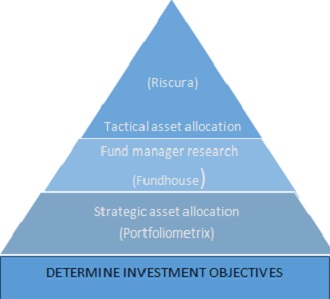
Strategic asset allocation
Brandon Zietsman, chief executive officer at Portfoliometrix, said the adviser carries clients from the present to the future, which means guiding them through the probabilities of the future. He says it’s not an accident that the top advisers in the country share the same qualities:
• higher engagement with clients so that they are able to get more information from the client;
• the ability to engender trust; and
• high emotional intelligence.
“The adviser has to take the information available to them – the client’s income and expenses; their assets; the contributions to their asset base; their planned retirement date; their expected income in retirement – and use this information when determining a strategic asset allocation to help the client achieve the desired outcomes,” he said. However, this analytical process needs to be balanced with the knowledge that not everyone is hardwired to handle the “pain” of a high-risk investment portfolio.
Fund manager research
Once an adviser has helped their client to define their investment objectives and determine the right strategic asset allocation to achieve those objectives, he then has to help the client choose the right mix of funds within that asset allocation.
When it comes to choosing a fund manager, Ian Jones, director at Fundhouse, noted that there are a few factors that complicate the process. These include the possibility of a key portfolio manager leaving or the business changing and a lack of information such as fund fact sheets and regular investment road shows.
There are 1600 funds available to choose from in South Africa alone. Jones says the starting point is your investment process, which can help you choose funds by filtering out the funds you don’t want to invest in. For example, if your investment process says you don’t use passive funds, then you can filter out all the passive funds. Your investment process guidelines may say you don’t use any fund of funds and that would filter out half the funds.
Tactical asset allocation
Jarred Glansbeek, chief executive officer at Riscura Solutions, explained the asset allocation ranges should be determined in such a way that if the adviser gets it wrong, it shouldn’t damage the client’s long-term financial prospects. “When putting together tactical asset allocation limits, you need to have a view of the different asset classes and how they perform. Your starting point would be a valuation of the asset class,” he said. For example, when it comes to listed property Riscura compares the property yield or the percentage of rental income and compares it to government bonds. This means relating two asset classes that generate income while recognising that all asset classes perform differently.
Investment advice can be tricky but using the right partners and innovative products can help an adviser significantly boost returns for his client.

