Mind the gap - assuring your medical care amid NHI uncertainty
While the National Health Insurance (NHI) promises universal coverage, the reality is that South Africans could face years of uncertainty, legal battles and implementation delays that leave critical gaps in healthcare protection.
This is according to Tiago de Carvalho, CEO of Ambledown Financial Services, who says: “South Africans face an increasingly complex and costly medical landscape, but healthcare cannot wait for the NHI to get up and running.”
The NHI reality check
The National Health Insurance (NHI) Act was passed by Parliament in June 2023 and signed into law by President Ramaphosa on May 15, 2024, establishing a single National Health Insurance Fund charged with strategically purchasing healthcare services, with the goal of providing public access to care that is "free at the point of care" after formal registration.
However, the NHI Act remains inactive as no effective implementation date has been proclaimed either in whole or in part. “This means the Act exists on paper but remains inactive – a legal framework waiting for an implementation command that may be years away,” he says.
At the same time, the courts are now the primary battleground for South Africa's healthcare future. Multiple organisations have filed court papers seeking to overturn the NHI Act, with challenges mounting from several fronts. Stakeholders including medical schemes, the South African Medical Association (www.medicalbrief.co.za, April 2025), and private practitioners argue that the Act infringes on fundamental constitutional rights, including the rights to freedom of association and economic activity, freedom of trade, occupation, and profession, the right to property, and the right to access health care.
Concerns have also been raised about parliamentary overreach on money bills and the lack of concrete details on financing, reimbursement and benefit design.
There have been a few legal challenges. The South African Private Practitioners Forum (SAPPF) is challenging the Act's constitutionality, arguing it threatens the viability of private practice by violating Sections 22 and 25, limiting economic freedoms, and failing to provide adequate consultation. In an academic paper cited by Business Day, Prof. Alex van den Heever (Wits University) described the NHI Bill as "fatally flawed," citing the improper delegation of legislative powers to unelected advisory bodies. He argues this undermines the separation of powers and could collapse existing healthcare services, thereby threatening Section 27 (the right to access healthcare services).
Significantly, in July 2024, the Gauteng High Court ruled that government legislation controlling where doctors could practice was unconstitutional, a decision many legal experts see as foreshadowing the potential NHI outcomes. An appeal by the National Department of Health regarding this matter was heard in September 2025.
The Uncomfortable Truth About Implementation
De Carvalho says: “The NHI Act was intended to be phased in gradually from 2024 to 2028. However, the practical realities paint a picture of immense complexity. Among the challenges in the way of NHI in the first phase of implementation are the fact that no clear funding mechanisms have been finalised. Contracting Units for Primary Healthcare (CUPs) are not yet in place and provider accreditation processes remain undefined.”
Phase 2 and Beyond: Conditional Expansion
De Carvalho stresses that progression to Phase 2, which would include hospital and specialist services, is entirely contingent on financial and institutional readiness. The redefinition of medical schemes to "complementary cover" will also require immense legal and operational clarity to avoid market chaos.
The Staggering Scale of the Financing Challenge
The funding required for the NHI is monumental:
• According to the South African Institute of Chartered Accountants (www.saica.org.za, June 2024), the annual cost of the NHI is estimated at around R450 billion.
• Economist Peter Attard Montalto (Intellidex) estimated a range of R300–R460 billion annually (www.dailyinvestor.com, June 2023).
This comes as the IMF reports that South Africa faces public debt exceeding 75% of GDP, stagnant growth, and a shrinking tax base (www.treasury.gov.za, January 2025).
De Carvalho stresses that progression to hospital and specialist services is entirely contingent on financial and institutional readiness. The redefinition of medical schemes to "complementary cover" will also require immense legal and operational clarity to avoid market chaos.
The funding challenge goes beyond numbers, he says: “Even the most modest phase of implementation requires financial discipline and growth – neither of which currently characterises the South African economy. If the first step is unfunded, the rest of the plan becomes meaningless.”
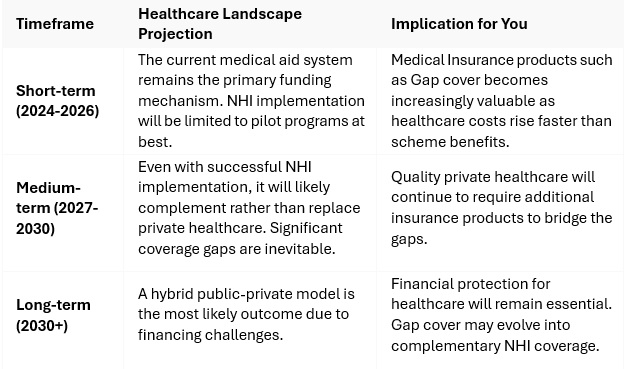
Even with successful NHI implementation, it will likely complement rather than replace private healthcare, he says. “A hybrid public-private model is the most likely outcome due to financing challenges, and significant coverage gaps are inevitable. Quality private healthcare will continue to require additional insurance products to bridge the gaps.”
He predicts that the evolution of NHI implementation process will take place over the following timeframe: