

The economy sweats – BankservAfrica Index
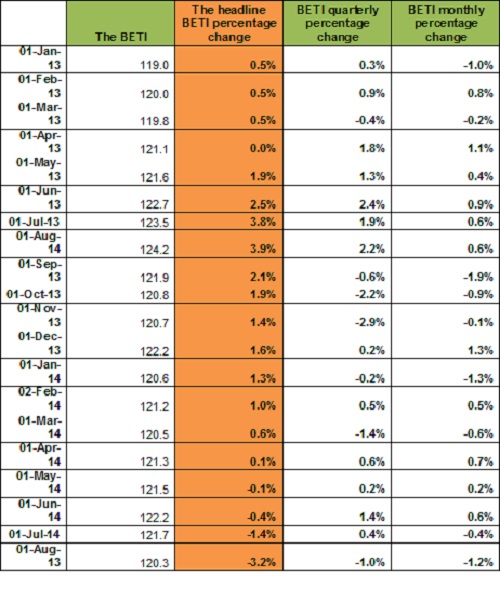
Real economic transactions are declining at the fastest rate in four and a half years, according to the BankservAfrica Economic Transactions Index (BETI). The August BETI stood at 120.3 which is 3.2% lower than last year. This shows that we are, once again, on the verge of a declining economy.
This is the biggest annual decline since February 2010, when the South African economy was just emerging from recession. The last four months have seen year-on-year declines.
Again, the BETI weakened the month after the strike ended. This indicates that the most difficult month is often the first month after a long strike as payments to strikers would generally not yet have taken place.
While much of the annual decline could be ascribed to base effects, it seems clear that recent declines in business confidence are also pushing the BETI down in the shorter term.
The BETI also saw a sharp 1.2% fall on last month, indicating weak August transactions. This is the biggest monthly decline since January this year. Seven of the last 12 months have seen declines while only five have seen growth in economic transactions.
The quarter-on-quarter data also declined by 1% and is the first quarterly decline since March. Six of the last 12 BETI releases have seen quarterly declines and this, too, indicates that economic growth is stagnant.
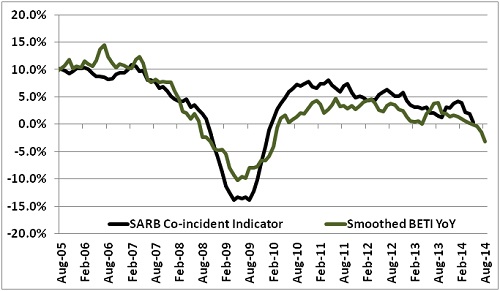
BETI and the co-incident indicator
Source: BankservAfrica and Economists.co.za
All the data from economic transactions that took place in August show an economy that is weak and uncertain. While other indicators also continue to show decline, the BETI is again showing a greater decline than most other indicators, which was not the case in the second quarter.
The volatile nature in the shorter term indicators of the BETI shows up as a negative longer term trend.
The weaker BETI probably indicates that the broader service sector is now struggling as much in manufacturing and car sales.
With both the PMI and new car sales in multi-month declines, the BETI seems to be showing a stronger declining trend in August.
Higher inflation has certainly taxed consumer and enterprise budgets more than in the recent past.
Also, the stronger credit criteria that banks have instituted in recent years is clearly having a negative effect on the total value of debit transactions which have been declining for the past ten months. The actual number of total debit transactions has also declined on last year for the last two months.
This is the first time that the total number of debit transactions have declined year-on-year for two consecutive months since the BETI data started in 2002!
This, along with weak credit growth, indicates that South Africans are less likely to commit to longer term debt commitments and that there is possibly a rise in cash transactions – or at least that newer debit commitments require higher deposits.
According to the BETI, the risk of another decline in the economy this quarter is certainly likely. With the close historic relationship that the BETI has both with the SARB co-incident indicator and economic performance, the risk of another decline cannot be ruled out.
Some indications that the cycle is about to turn up again
The full production of the platinum mines, which had the longest major strike action in South African economic history, is only likely to return in the fourth quarter, while the metal industry is only likely to get full production back by September.
The fact remains that the losses from before still seem to be influencing the economic health – perhaps indicating that while the worst is happening now, the chances of an uptick later in the year is looking better.
Added to this good news is that, at present, the major strikes seem to be over for 2014 and that the working day is likely to return to normal, which should improve confidence. This will help add to confidence.
Also, the inflation rate peaked in the short-term and with the fuel price rushing down one can expect that South Africans will have a little more discretionary spending power again.
When looking purely at the BETI data, it is expected that the full recovery of the economy will only take place later in the fourth quarter and the risks are still higher than usual.
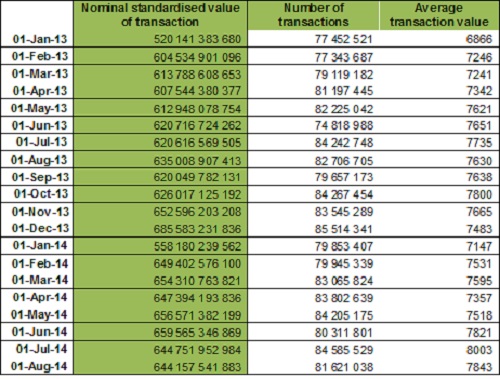
The actual number of transactions declined for the first time in nearly four years. The total number of transactions used in the BETI decreased by 1.3% on last year to 81.6 million. This is the first decline since October 2010. It is possible that the increase in interest rates are having a very quick effect, but one will have to wait for a few months to see if this would hold in the coming months.
The total value of the transactions was R640.2 billion, which increased by 1.4% in nominal terms and is far below the estimated inflation rate. The average value of transactions increased by 2.8% on last year to just under R7 900.
Once again the raw data indicates weaker economic in the economy. Value judgements cannot be made on just one month - however, the last two months seem extremely weak and if this current trend continues, economic health will be a concern.
The standardised BETI, after taking the number of workdays into account, was R644.2 billion which was also up by 1.4% in nominal terms. The deflator used was 6.7% and is a combination of both consumer and producer price changes.
Table 1: The BETI and percentage changes
Source: BankservAfrica and Economists.co.za.
Table 2: Standardised transaction values and number of transactions
Source: BankservAfrica and Economists.co.za

