

South Africa: Speculative status looms after the controversial cabinet reshuffle
On March 30th, after a week of speculation on Pravin Gordhan’s future, Jacob Zuma, South African president, sacked his Finance Minister in a cabinet reshuffle.
Jacob Zuma axed five other Ministers and four Deputy Ministers, and moved some Ministers to new portfolios.
At odds with the President on the budgetary stance, Mr Gordhan was considered the last beacon of policymaking stability in Zuma’s administration by investors and many senior officials of the African National Congress (ANC). Rated one notch above speculative grade (BBB-) by two of the three credit rating agencies, the Minister’s departure will probably be synonymous with the loss of the investment grade status.
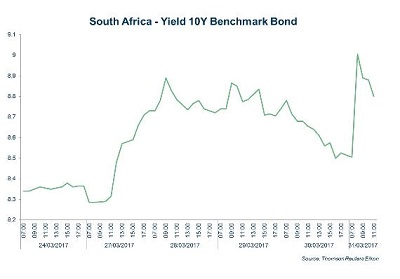
Hit by acute volatility last week, the rand tumbled (-2% on March 31st morning and -7% in a week, the worst performance since December 2015) and yields on South African government bonds jumped (see graph).
Home is where the hatred is
Mr Gordhan’s sacking comes as no real surprise after a week of increased political uncertainty. President Zuma kickstarted the week on Monday by ordering his finance Minister to return back home “immediately” from an investors roadshow in the UK and United States with no reason.
This recall revived speculation of Gordhan, who has been in a hot seat for month, being fired by the President. On Tuesday, Gordhan said upon his arrival that he was still Finance Minister. On Wednesday, the funeral of Ahmed Kathrada, anti-apartheid activist who spent 26 years in prison, crystallised the internal divisions of the ANC. Finally, late on Thursday, President Zuma sacked Mr Gordhan in cabinet reshuffle. He was replaced by Minister of Home Affairs, Malusi Gigaba.
The guardian of policymaking stability in a challenging macroeconomic environment the Finance Minister, appointed in December 2015 after a messy cabinet reshuffle, had to find a difficult balance between fiscal consolidation and reviving growth.
A rise in public debt fuelled by a ballooning fiscal deficit has rattled for months investors and rating agencies on the ability of South Africa to manage its public debt. S&P and Fitch are currently rating the South African sovereign risk just one notch above speculative status, with a negative outlook since December 2015 for S&P.
In office, Mr Gordhan pushed for fiscal consolidation to restore confidence and the credibility of the fiscal policy but conflicted with the President on these key policy issues. It is worth mentioning that President Zuma, who survived an impeachment vote because of corruption allegations in April, was also at odds with his Finance Minister, who has a reputation for fighting corruption.
The challenging macroeconomic environment is being fueled by a severe economic slowdown with GDP growth at 0.3% in 2016 and subdued growth prospects for 2017 (Coface forecasts +0.8%). Crippled by the lack of competitiveness and persistent issues with electric supply, the economy mostly suffers from weak household consumption, a traditional driver of growth in South Africa, because of high inflation (6.3% y-o-y in February 2017) and unemployment (26.5% in Q4 2016).
Risks
Gordhan’s sacking could lead to a further deterioration of the economic outlook including rating downgrades by rating agencies. Losing the investment grade status would raise borrowing costs and worsen the financial position of the State, accelerate capital outflows, rand depreciation, and so lead to further inflation pressures.
With growth at 0.3% in 2016 and growth forecast below 1% in 2017 and still adverse macroeconomic circumstances (low commodity prices and weak business confidence), the risk of the South African economy falling into recession cannot be excluded. Mr Gordan’s replacement is likely to hurt confidence in the short-term.
President Zuma, weakened by allegations of misappropriation and corruption, faces growing internal divisions inside the ANC. The cabinet reshuffle further undermines his authority and threatens to split the ANC ahead of the party elective conference in December 2017. For instance, Deputy President and ANC secretary general Cyril Ramaphosa spoke out to say that Gordhan’s firing was “unacceptable”.
The party conference will be crucial as the ANC needs to pick a successor for President Zuma to assume party leadership. The newly appointed leader will certainly be a candidate in the 2019 presidential election after Zuma completes his second and ultimate term. Divisions will limit the ability of the government to define and implement reforms.
Social upheavals is also a concern. Popular discontent – fuelled by high inflation, low wage raises and high unemployment is growing as evidenced by recurrent demonstrations and recent xenophobic attacks targeting nationals of Nigeria and Zimbabwe. All in all, Zuma’s decision to sack his Finance Minister increases substantially risk in South Africa, with major economic, political and social consequences at stake.

