

South Africa slips into technical recession
South Africa economy contracted in Q1 2017 by 0.7% (q-o-q, annualised), following a 0.3% contraction in Q4 2016, moving the country into a technical recession.
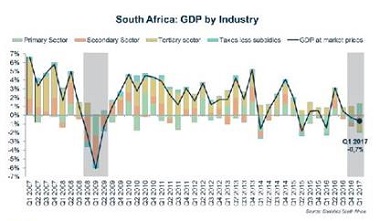
There were expectations of a 0.9% expansion. With unemployment at a record 27.7% in Q1 2017 and inflation still close to the upper end of the inflation target range, the retail and hospitality sectors are expected to continue to face challenges in 2017.
A rebound in the agricultural sector, which grew solidly in Q1, is likely to support a gradual recovery from the 0.3% growth in 2016. Heightened political uncertainty after the controversial cabinet reshuffle and fuelled by the President facing fresh corruption allegations, seems unlikely to deflate in the next months. For those reasons, Coface has maintained its forecast of 0.8% GDP growth in 2017.
Weaknesses in consumer sectors
Poor performances in the wholesale, retail, catering and accommodation (-5.9%), manufacturing (-3.7%) and construction sectors (-1.3%) suggest that the 13-year high unemployment rate (27.7%) and stagnant wages (+0.2% in the BankservAfrica Disposable Salary Index in Q1 2017) dragged down the consumer sectors in South Africa.
Weak household consumption, a traditional driver of growth in South Africa, has slowed dramatically since the 2008-2009 crisis. After the cabinet reshuffle, (See Brief: ‘South Africa: Speculative status looms after the controversial Cabinet reshuffle’, March 2017) Coface warned that a recession risk was likely to materialise with subsequent credit rating downgrades to “speculative” status by S&P and Fitch ratings.
The primary sector prevent a further dip
The only positive note in the data was in the primary sector. As expected, the latter rebounded. Mining and quarrying (+12.8%) contributed 0.9 of a percentage point to GDP growth, in part due to a favourable base effect after the sector contracted close to 5% in 2016.
The silver lining came from the agricultural sector (+22.2%), which contributed 0.4% to GDP growth. This sector is benefitting from normalising weather conditions after a severe El Niño induced drought in 2015/2016 had a devastating impact on agricultural output.
The latest forecast from the Crop Estimates Committee for 2017 summer crops were revised upward (+6.5%) mostly due to better-than-expected maize/corn production. The rebound in the primary sector should support higher growth in 2017, according to Coface.
Economy in tatters, Zuma in the doldrums
President Jacob Zuma’s poor economic record is likely to put renewed pressure on him who is facing fresh corruption allegations. 100 000 leaked emails revealed by the media showed possible inappropriate interference in tenders. The police opened an investigation over government corruption on June 5th, just one day before the GDP data release.
Nevertheless, the President - who survived accusations of graft and rape before he took office in 2009, as well as an impeachment vote last year (because of corruption allegations) and a no-confidence motion within the African National Congress (ANC), his party is again being questioned but still in place. He will probably remain in power until the ANC Conference in December 2017, when a successor is to be chosen, if not then until the end of his term in 2019.
Risks - Bleak prospects for 2017, possible prolonged recession
This dismal performance in Q1 2017 came before the credit rating downgrades, which has knocked consumer, business and investor confidence. Hence, a recession may settle in for a few additional quarters. Supported by the primary sector industry, namely agricultural and mining output, activity in South Africa may even grow 0.8% in 2017. Nevertheless, these two sectors are vulnerable to external factors such as weather conditions that could undermine already weak growth prospects.
Social upheavals more and more likely
Popular discontent, fuelled by high inflation, low wage raises and high unemployment, is growing as evidenced by recurrent demonstrations and recent xenophobic attacks targeting nationals from Nigeria and Zimbabwe. Nationwide protests to ask for Zuma’s exit after the controversial cabinet reshuffle demonstrated publicly South Africans’ discontent which was growing at an average rate of 5% before the crisis.

