

SA economy’s ‘Achilles heel’ - debt vulnerability heightened in 2015
MMI Unisa Consumer Financial Vulnerability Index reveals consumers’ perceptions of their financial positions.
South African consumers are on the brink of the equivalent of junk bond status in terms of their financial vulnerability, as revealed by the latest MMI Unisa Consumer Financial Vulnerability Index (CFVI).
The CFVI is a robust quarterly indicator of consumers’ perceptions about their financial positions (which impacts GDP), that tracks vulnerability status in terms of income, expenditure, savings and debt servicing. The index is the product of collaboration between MMI Corporate & Public Sector, the division within MMI Holdings that services large and medium sized businesses, and Unisa.
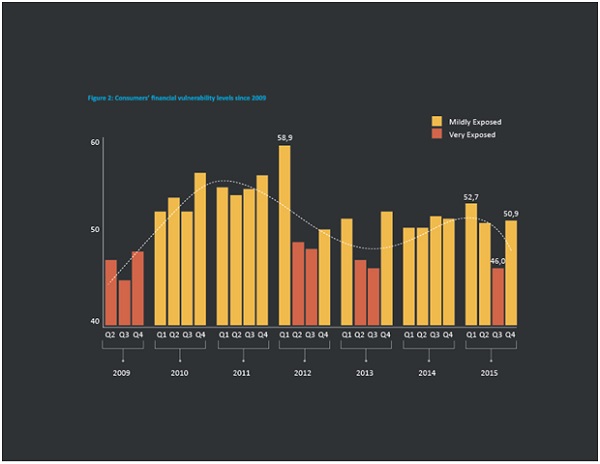
The latest CFVI shows that by the end of 2015, local consumers in general remained alarmingly close to the Very Exposed classification. The overall index for Q4 2015 sits at 50.9 index points which is on the lower end of the Mildly Exposed band.
The figure is relatively steady year-on-year but down from a “less vulnerable” high of 58.9 recorded in 2012.
SA consumers’ financial vulnerability levels since 2009
Shelley van der Westhuizen, Head of Corporate Financial Wellness and Client Experience at MMI Corporate & Public Sector, says: “We exist to increase business financial wellness by helping our clients to grow their income statements, protect their balance sheets and enhance their sustainability throughout the business life cycle.
“As part of this, we have a responsibility to conduct and present research that enables us to enter into meaningful and relevant conversations around what is driving company growth, employee productivity and corporate longevity with our clients. Enter the Consumer Financial Vulnerability Index; the first in a series of indices in the MMI Business Financial Wellness Guide which aim to enhance a business’ financial wellness through engaging on and solving together for the impact of a number of variables.”
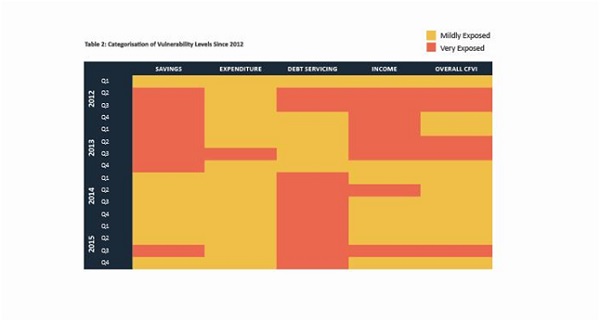
The real concern from the 2015 CFVI lies in the debt servicing numbers which have remained in the Very Exposed band for two years and are now at 48.7, the lowest since the introduction of the CFVI in 2009.
Categorisation of vulnerability levels since Q1 2014
Jacolize Meiring, Senior Researcher at the Department of Taxation at Unisa says: “The increases in interest rates during 2015 have obviously contributed to this feeling but, even before that, the majority of South Africans were clearly very concerned about their ability to manage their debt.
“This is our ‘Achilles heel’ because the debt trap damages financial wellness and vulnerability levels in every area. Discretionary saving levels are low or non-existent and income is diverted to this debt trap by attempting to service arrear debt instead of balancing the household budget. While income, expenditure and savings vulnerability are heavily influenced by macro-economic performance, debt servicing capabilities are also impacted on by institutional dynamics and consumer attributes, such as low levels of financial literacy.”
Analysts at MMI believe that the likelihood of the overall CFVI index slipping into the Very Exposed category during most of the quarters of 2016 is very high given the gloomy growth and unemployment environment, and the inflationary pressures on consumer spending.
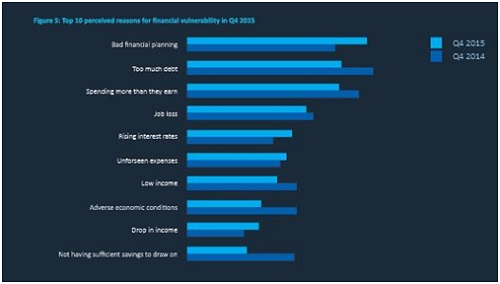
However, the good news is that unlike macro-economic variables largely outside of the consumers’ control, for debt servicing, the situation can be improved through effective planning and sound management. The Q4 2015 CFVI showed respondents listing ‘bad planning’ as the primary cause of their financial vulnerability.
Van der Westhuizen says this offers a huge opportunity for employers: “Debt-stressed employees are inevitably less effective which has a significant impact on the profitability of a business. It is largely encouraging, however, that these stressors can be relieved to the great benefit of both the individual and the business through the structured provision of guidance and holistic management within the workplace.”
Top 10 perceived reasons for financial vulnerability in Q4 2015
To see CFVI Report - Results click here.

