

Looming elections bring continued political uncertainty as more businesses delay investment decisions - Grant Thornton quarterly survey
Grant Thornton IBR survey for Q1 2014 reveals local government issues dramatically hampering business expansion.
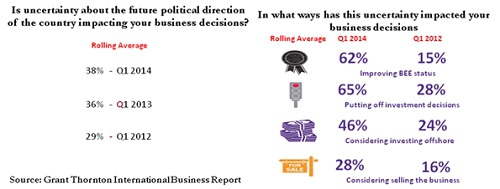
According to the latest quarterly tracker survey from Grant Thornton, 37% more businesses are putting off investment decisions due to political uncertainty compared to data recorded just three years earlier (Q1: 2014 – 65% vs Q1 2012 - 28%).
Grant Thornton’s International Business Report (IBR) survey for Q1 in 2014 highlights that, of the nearly 40% of business executives that believe that the future political direction of the country is affecting business decisions, more than 65% of these respondents are putting off investment decisions, holding back for now and hoping for a more stable economy first.
Grant Thornton South Africa’s national chairman, Deepak Nagar, believes that Wednesday’s national elections and political uncertainty associated with this voting day, is probably a core contributor to this statistic.
"It is natural when election time swings around, for uncertainty about the future political direction of a country to become unsure,” Nagar says.
Grant Thornton’s International Business Report (IBR) provides tracker insights for the first quarter of 2014 to March specifically presenting perceptions into the views and expectations of over 12 500 privately held businesses surveyed in total per year across 44 economies. It also highlights regional and national perceptions of privately held businesses regarding crime, service delivery and political climate for 600 South African business owners annually.
The good news is that the Grant Thornton IBR survey reveals that only 21% of South African businessmen have given serious consideration to leaving South Africa. This figure is just marginally higher than the 19.3% recorded in the previous quarter, at the end of 2013 (Q4: 2013), a statistic that has remained constant for nearly four years.
"The research here clearly shows that people are settled, comfortable and content in South Africa,” says Nagar. "Following this week’s general election, we assume that the political climate will normalise and we hope that it brings with it improved security and a more stable economy, both of which would go a long way to making our country stronger and more competitive overall.”
Poor Government Service Delivery adds concern to business stability
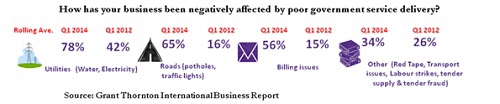
A growing concern for local business executives is the effect that poor government service delivery has on the business environment. For the first quarter of 2014, just over 60% have stated that their organisations have been negatively affected by poor government service delivery (Q1 2012: 53%).
The greatest service delivery issue for local businesses is that of basic utility services (water and electricity supply). During the first quarter of 2012, 42% of privately held business owners stated that utilities had negatively affected their businesses. Just three years later, this figure has nearly doubled to 78% for Q1, 2014. Road infrastructure concerns (such as potholes and traffic light issues) and the negative impact this has on SA business executives has tripled to 65% in January 2014 from just 16% during January 2012. Fifty six percent (15% during Q1 - 2012) of businesses flag billing issues as a constraint to doing business.
Nagar also comments that whatever the outcome of this week’s election, government service delivery must be at the top of the new administration’s agenda.
Crime continues to affect an increasing proportion of South Africans
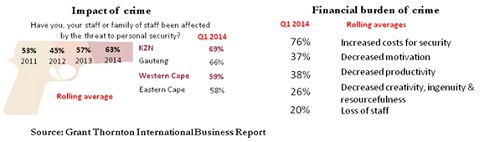
A disappointing 10% more South African business executives (including staff members and immediate family) have been directly affected by crime, compared to three years ago.
Grant Thornton’s International Business Report (IBR) quarterly tracker survey for the first quarter of 2014 highlights that 63% of business executives have reported a direct contact crime experience– either directly impacting their own families or affecting staff and families of staff. This is nearly 10% higher than statistics recorded three years ago in January 2011 (Q1: 2011 – 53%).
The greatest impact which crime has on businesses is that of the increased cost of security, which 76% of South African businesses flag as a financial burden they face, up more than 30% in three years (2011 – 44%).
Business constraints
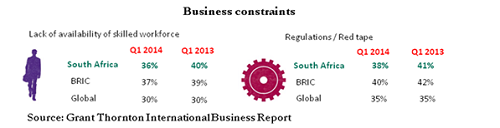
The issues of over-regulation and red tape, and the lack of availability of a skilled workforce have once again topped the charts as the two biggest constraints to business growth and expansion in South Africa. When asked to list constraints according to their impact on business expansion, 38% of South African business executives state over-regulation and red tape as a major cause for limited growth while 36% of business owners state that the lack of skills is constraining their expansion plans.
"This is not just a local concern, though,” says Nagar. "The IBR research reveals that SA statistics are on a par with the global data relating to a lack of skills (Global: 30%; BRIC: 37%; SA: 36%) and over-regulated business environments (Global: 35%; BRIC: 40%; SA: 38%). Limiting business growth by adding complex red tape to various processes is concerning, while a global skills shortage highlights that companies, governments and trade associations need to collaborate more to try and mend this issue once and for all.”
B-BBEE a central strategy for SA organisations
On a positive note, political instability is generating a surprising affirmative reaction from businesses with 62% of privately held business owners stating that the uncertainty in the future political direction of South Africa is prompting them to improve their BEE status. This statistic has more than quadrupled since January 2011 (15%).
"There is no doubt that recent amendments to the Broad-Based Black Economic Empowerment Act (B-BBEE) and the long term benefits that proper empowerment can bring to a business are starting to bring real, notable returns,” says Nagar.
Business optimism
Internationally, the optimism / pessimism pendulum has certainly started to turn. The IBR data reveals that 34% of businesses globally are optimistic regarding the economic outlook, the highest statistic recorded since 2007, and a 6 percentage point increase since January 2013. And this confidence is in evidence across the globe: in North America optimism is at its highest since 2004, and in the EU and Asia Pacific.
South Africa’s optimism for business prospects in the coming 12 months is unfortunately significantly down at 30% for the first quarter in 2014. This is a figure which has been steadily declining for four years since the much higher statistic recorded in the first quarter of 2010 (60%).
"When the next 12 months of business prospects are reviewed, it is concerning that our privately held business executives are so pessimistic. We assume this could be the long-term, Southern Hemisphere lag effect of the economic slowdown. It is clear to see that day-to-day business functions are sadly being hampered by a wide variety of macro-economic problems. These issues need to be addressed, and the new ruling party post 7 May, will have to collaborate with local and national government as well as the unions and other labour associations so that together steps towards an improved business environment can be achieved,” concludes Nagar.


