Interest rates hiked by a further 25 basis points

Jacques du Toit, Property Analyst, Absa Home Loans.
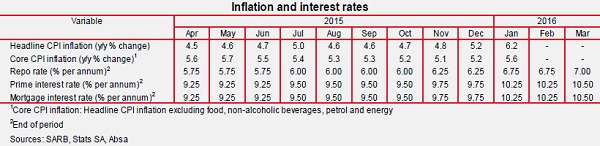
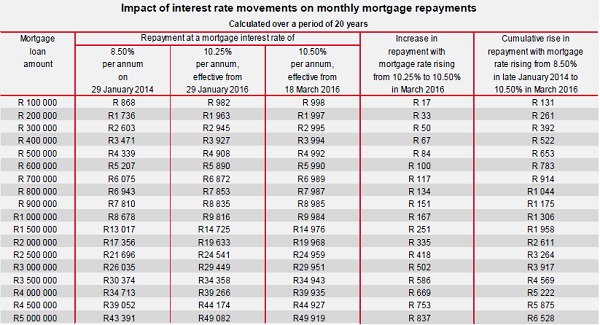
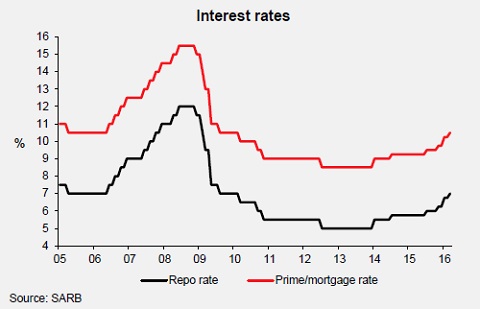
The South African Reserve Bank’s (SARB) Monetary Policy Committee (MPC) raised the key monetary policy interest rate – the repurchase, or repo rate – by a further 25 basis points from 6,75% to 7% per annum. Based on this hike in the repo rate (the rate at which commercial banks borrow funds from the Reserve Bank), Absa announced that its prime lending and variable mortgage interest rates will rise from 10,25% to 10,5% per annum, effective from 18 March 2016. Lending rates have risen by a cumulative 200 basis points since the start of 2014 and by 75 basis points since January this year.
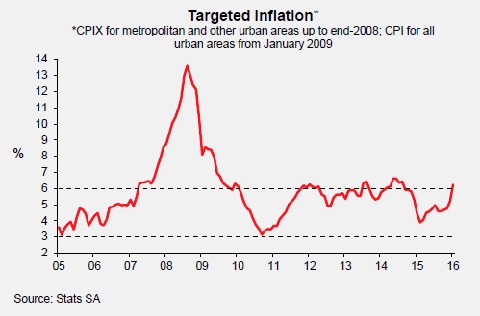
The abovementioned further hike in interest rates came against the background of still mounting inflationary pressures, driven by factors such as the rand exchange rate, food prices, electricity tariffs and oil and fuel prices. The latest trends in and the Reserve Bank’s forecasts in respect of these key inflation factors are presented below.
• The rand exchange rate remains weak against the major international currencies, with the real effective, or trade-weighted, exchange rate forecast to depreciate by 11% this year from 2015. A possible country credit rating downgrade may lead to further rand exchange rate depreciation and increased economic stress.
• Food price inflation has jumped from 4,3% year-on-year (y/y) in June 2015 to 7% y/y in January this year, with a continued upward trend expected due to the impact of severe drought conditions in many major food-producing areas of the country since last year. Real agricultural production contracted during all four quarters of 2015, declining by 8,4% from 2014. However, prospects for the next planting and production season do not look promising.
• Further electricity price hikes were recently announced, which will contribute to inflationary pressures. Electricity prices are projected to rise by 9,5% next year and 10% in 2018.
• International oil prices have been increasing since a recent low in January, which may lead to higher domestic fuel prices and some upward pressure on headline consumer price inflation. Brent crude oil is forecast to average $37/barrel in 2016, $45/barrel in 2017 and $50,50/barrel in 2018, with petrol prices expected to remain relatively stable this year, but to rise by 10,2% next year and 9,4% in 2018.
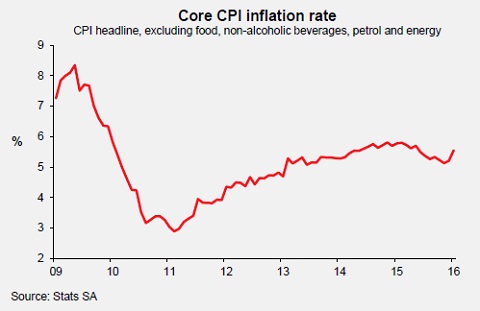
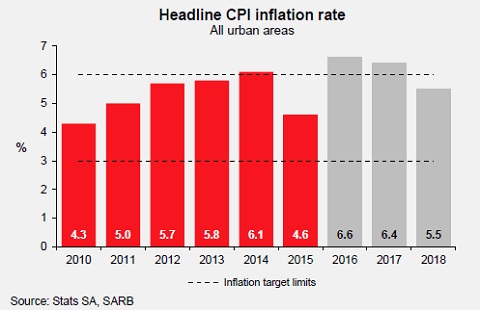
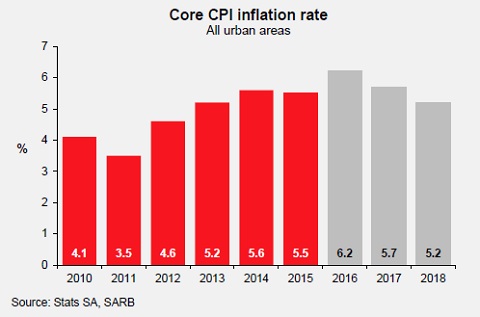
• Based on the outlook for abovementioned factors, the latest forecast is for headline consumer price inflation to average 6,6% this year, 6,4% in 2017 and 5,5% in 2018. Core inflation (see definition in the table below) is projected at 6,2% this year, 5,7% in 2017 and 5,2% in 2018.
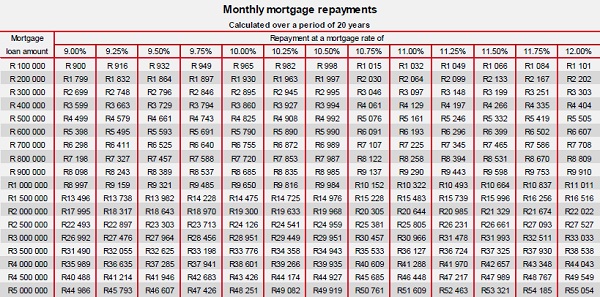
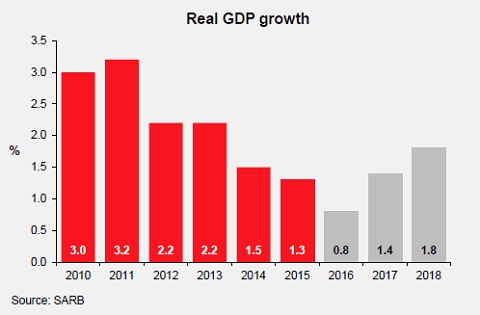
In view of trends in and the outlook for inflation, the forecast is for interest rates to rise further towards the end of 2016. Further interest rate hikes will cause debt repayments and debt-service costs to rise, adversely affecting household and business sector finances, consumer and business confidence, the demand for and affordability of credit, consumption expenditure, fixed investment decisions and economic growth. Growth in real gross domestic product (GDP) is forecast by the Reserve Bank at 0,8% in 2016, rising to 1,4% in 2017 and 1,8% in 2018.