GDP Data Comment
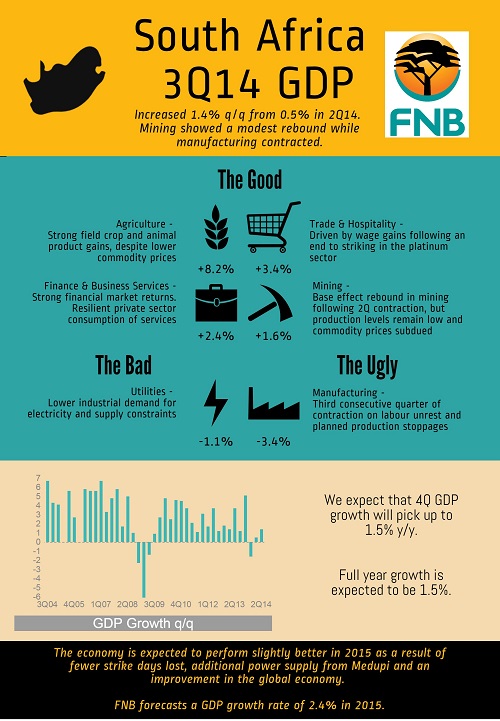
South Africa’s gross domestic product (GDP) grew by 1.4% quarter-on-quarter (q/q) annualised in 3Q 2014, after increasing by 0.5% q/q in 2Q. The drivers of the rebound were: trade and hospitality (+3.4% q/q), finance and business services (+2.4% q/q) and agriculture (+8.2% q/q). Mining also staged an encouraging recovery from a 3.1% q/q contraction in 2Q, to achieve growth of 1.6% q/q in 3Q. On the downside, manufacturing (-3.4% q/q) and utilities (-1.1% q/q) continued to see output decline.
The manufacturing weakness was largely due to the strikes in the metals and engineering segment. Meanwhile, strength in agriculture was due to a good crop harvest. The recovery in the trade sector was broad based, but it is coming off a low base and is likely driven by the return of striking workers in the platinum industry and the resulting wage gains (following large wage losses during the strike). The business and finance sector was boosted by strong financial market returns in 3Q. On a year-on-year (y/y) basis GDP grew by 1.4% in 3Q. For the three quarters of 2014 as a whole, GDP has grown by 1.5% y/y. We expect that 4Q GDP will pick up slightly to record growth of 1.5% y/y and as such full year growth is expected to be 1.5%.
In 2015, the economy is expected to perform slightly better in anticipation of fewer strike days to be lost (2014 saw the longest strike in SA’s history), the introduction of additional power supply from Medupi as well as an improvement in the global economy. FNB forecasts a GDP growth rate of 2.4% in 2015.
The 3Q numbers also contained revisions for previously published GDP data as a result of a re-weighting and re-basing exercise. In short, this involves adjusting the reference year from which GDP is calculated to 2010 from 2005, with the result that industries which have grown relatively rapidly in recent years will now have a higher weighting in GDP and vice versa. Moreover, there were also some minor adjustments made to the way GDP is calculated. The end result is that nominal GDP for each year going back to 2006, was revised higher by between 2.8% and 5%. For 2013 nominal GDP was revised up by 4.4%. Real GDP growth in previous years was also revised slightly. For 2013 real GDP growth was revised up from 1.9% to 2.2%. However for 2012 real GDP growth was revised down from 2.5% to 2.2%.