

Fitch retains stable outlook, but warns against weak economic growth

Sanisha Packirisamy, Economist at MMI Holdings.

Herman van Papendorp, Head of Asset Allocation at Momentum.
A positive outcome by Fitch rating agency followed an earlier decision by Moodys and S&P to leave SA’s ratings unchanged at Baa2 (with a negative outlook) and BBB- (with a stable outlook), respectively.
Fitch affirms SA’s foreign currency sovereign rating at BBB- and retained a stable outlook
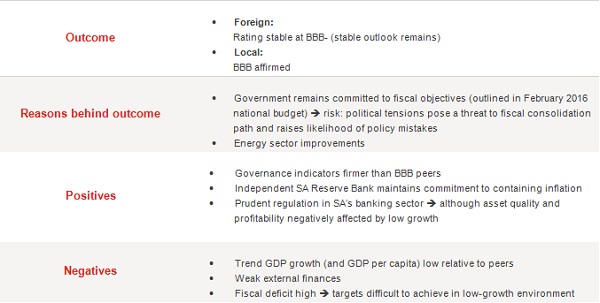
Fitch kept SA’s long-term foreign currency sovereign credit rating at BBB- (local currency rating affirmed at BBB) and retained a stable outlook, stating that the current “rating reflects low trend GDP growth, significant fiscal and external deficits and high debt levels which are balanced by strong policy institutions, deep local capital markets and a favourable government debt structure.”
Fitch acknowledges an increase in political risk since December 2015
Although political risk does not appear to be out of line with SA’s BBB-rated peers, the finance ministry debacle and tensions within government have alerted Fitch to a rise in political risk since its previous review in December 2015. The main concern here is whether or not Treasury remains committed to sustained fiscal consolidation and whether prudent governance of SA’s state-owned enterprises can be achieved. While political risk in itself has little bearing on the assessment, its impact on the economy and public finances are crucial to SA’s sovereign rating.
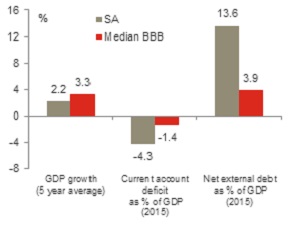
Chart 1: SA comparison with median BBB-rated country
Source: Fitch, Momentum Investments
Many structural indicators weaker than peer group, but governance indicators are still relatively firmer
Fitch warned that a number of structural indicators (including trend GDP growth, GDP per capita, current account imbalance and net external debt ratio) look weaker for SA relative to the median of its BBB peer group (see chart 1), but noted that governance indicators remain slightly stronger on a relative basis. The rating agency noted that SA’s institutions have proved to be robust notwithstanding the rise in political tensions over recent months.
Low-growth environment raises the risk of buckling under socialist demands
Local government elections pose an additional risk. An escalation in the number of service delivery protests and rising speculation that the current ruling party may see weakening support in the upcoming elections could increase the urgency to ramp up expenditure. Against a subdued growth backdrop, achieving higher levels of expenditure will be challenging and could threaten government’s commitment to its self-imposed expenditure ceiling.
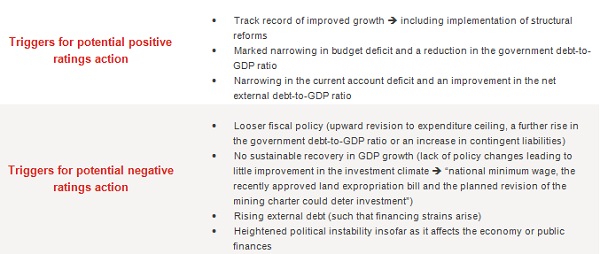
Table 1: Summary of Fitch’s mid-year review
Source: Fitch
Consequences of low growth and a lack of growth-enhancing structural reforms a risk to ratings down the line
The three key rating agencies (Moodys, S&P and Fitch) have all acknowledged Treasury’s commitment to sticking to the expenditure ceiling and stabilising the debt ratio. Though political risk has risen over recent months, the rating agencies have reiterated the strength of SA’s institutions in a tough economic climate. Nevertheless, they admit to rising fiscal risks against the backdrop of low growth. The necessary implementation of growth-enhancing reforms has been reiterated by all three rating agencies as a way to positively influence SA’s longer-term trend growth through securing a healthier investment climate and enhancing relative competitiveness.
Our own internal growth forecasts of around 0.5% this year and slightly above 1% in 2017 suggest that revenue collection could come under significant strain particularly in the absence of additional tax proposals. With government’s burgeoning civil servant wage bill and onerous debt-servicing costs crowding out more useful forms of expenditure, the outlook for government fixed investment spend and overall growth remains at risk.
We maintain our view that higher rates of economic growth can be cultivated by implementing key reforms in the labour and mining sector in particular. Addressing the challenges that face vital state-owned enterprises are also key in unlocking a higher growth potential in SA. Nevertheless, rising political tensions in a low-growth environment raises the risk of buckling under socialist demands and endorsing policy measures that could damage SA’s investment climate, posing a significant threat to SA’s sovereign rating outlook. We continue to see a more-than-even chance of a rating downgrade to junk status by at least one of the three rating agencies (namely S&P) in December this year (year-end review set to take place on the 2nd of December 2016), with a high probability attached to Fitch shifting their outlook to negative around the same time.

