

Faster, then slower – but growth it is!
Economic activity has moderated somewhat in April 2022, but the South African economy is still growing. We have probably reached the peak of commodity price levels, but the prices will likely remain elevated for some time to come, which will continue to support the country’s mining and related sectors.
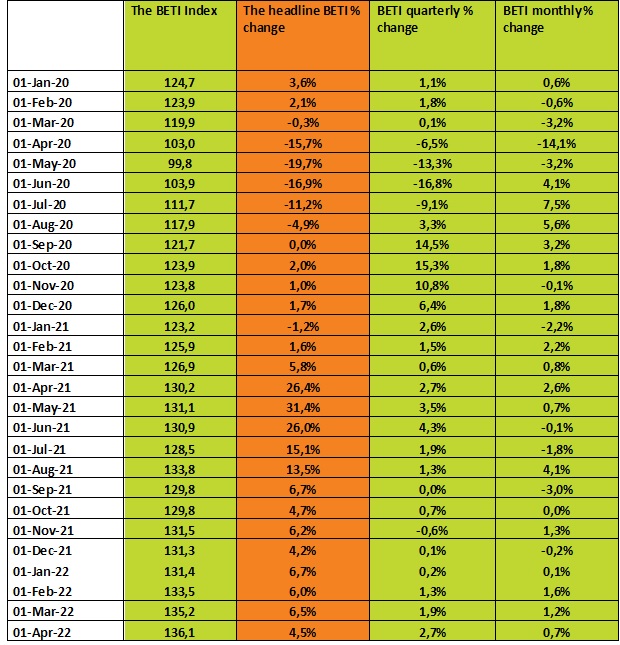
The BankservAfrica Economic Transactions Index (BETI) increased by a steady 4.5% compared to a year ago, reaching the actual level of 136.1. While other nowcasting indices also eased, the BETI still shows growth on a yearly, quarterly, and monthly basis.
While the BETI suggests that the Q2 2022 is off to a steady start, there are several headwinds looming that could potentially derail the economic momentum in the next few months. Stringent economic lockdowns in China have placed global supply chains under renewed pressure, while fuel prices have rocketed worldwide, not only putting households’ disposable income under pressure but also pushing both consumer and producer prices to sky-high levels. The March CPI (Consumer Price Index) in the United States rose to 8.5%, which is at the highest level in 40 years. Subsequent monetary policy tightening, which has now become a worldwide phenomenon, will play into softer economic growth rates globally.
Although the prices of our main export commodities remain elevated and should cushion the economy somewhat, South Africa is in the same boat, with rising inflation rates (SA’s Producer Price Index reached 11.9% in March 2022), mounting interest rates and surging fuel prices. Furthermore, the economy was hit by major disruptions in April, most notably the devastating flooding in KwaZulu-Natal (KZN), but also several days of stage four load-shedding.
A significant negative impact on the local manufacturing sector is concerning. The Absa Purchasing Managers’ Index (PMI) dropped to a barely positive 50.7 in April, down from 60.0 in March. This is the lowest PMI reading since July 2021, when production was affected by the looting and rioting in KZN and parts of Gauteng, as well as stricter lockdown regulations. A sharp decline in export sales was also reported in April 2022, most likely due to a combination of flood-induced logistical constraints, the temporary closure of the Durban harbour and the weaker external demand.
Another indicator, confirming the moderating trend in activity, is the non-seasonally adjusted domestic new vehicle sales that came in at 37 107 units in April, falling from 50 607 units sold in March. Sales were not only affected by the considerable number of public holidays during the month, but also by the supply chain constraints which were exacerbated by the floods. However, the automotive industry performed well relative to last year as total local sales increased by 4.3% year-on-year in April (like the BETI), while sales were up by 0.9% compared to April 2019 (pre-pandemic)
Against this background, the fact that the BETI held up so well in April symbolises the resilience of the South African consumers and businesses.
Robust growth in the number of transactions
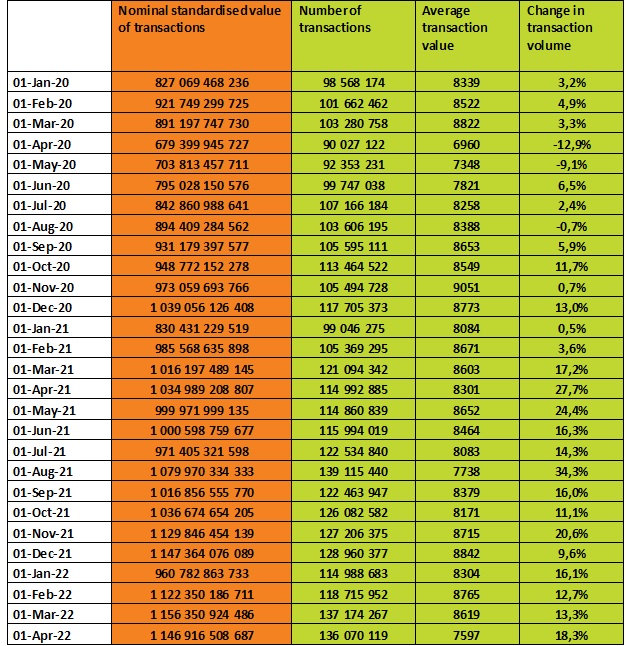
The standardised nominal value of transactions reached R1.147 trillion in April 2022. Meanwhile, the volume of transactions increased to 136 billion.
Table 1: The BankservAfrica Economic Transaction Index
Source: BankservAfrica and Economists.co.za
Table 2: The volume and average value of transactions and the standardised BETI in nominal terms
Source: BankservAfrica and Economists.co.za


