

BETI shows SA economy recovering but at a snail’s pace
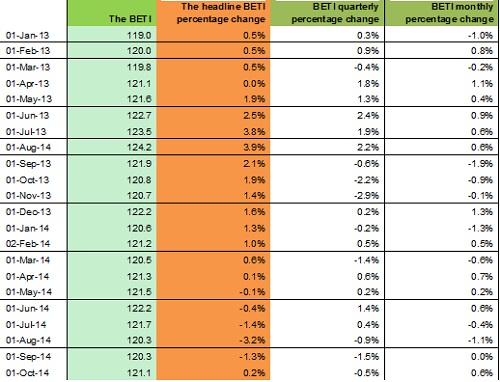
The first positive BankservAfrica Economic Transaction Index (BETI) in six months shows that the South African economy recovered in October. Despite the low 0.2% reading, it is the best number in seven months, and the monthly change which increased by 0.6% on September makes for quite positive reading.
Certainly stronger and more robust economic trends are being felt and reflected in the BETI, but the quarterly numbers are still negative – mainly due to a very weak August.
The actual BETI number was 121.1, which was the highest in three months, further reinforcing the recovery trend. Although this recovery is becoming entrenched, the speed is still debatable.
Once the next set of numbers come in it is very likely that the quarter-on-quarter changes will also be positive. However, the November data may yet have its own problems due to power constraints.
The post office strike may be affecting cheque transactions more than people realise
What is, however, still a problem is that strikes, such as the post office strike, are still impacting negatively on economic performance. Many postal cheques have probably been delayed and this is reflected in the fact that the number of cheque transactions declined by over 30% for the first time since April, when there was also a partial post office strike.
Cheque transactions are generally in decline as banking is becoming more electronic in nature; however, a 30% decline year-on-year has only happened on three previous occasions: twice during post office strikes, and once when the rules for cheques changed.
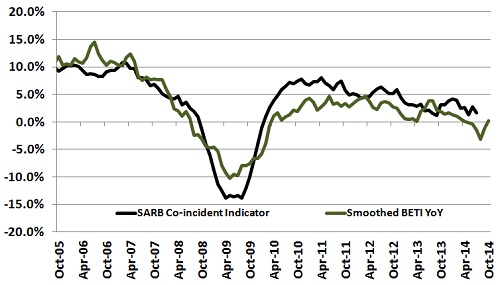
The average decline of 26.2% over the last 12 months is also very high. Although not all of this would be due to the post office strike, some of it certainly will be. Along with other economic indicators showing a recovery, the BETI is generally back on a much better trend from that of a very negative mid-year trend.
Actual transaction numbers are recovering in general while nominal values are unusually strong
Overall, the number of transactions reached a new record, and at 88.4 million for October the economy seems to be getting back on its feet. However, infrastructure constraints like power outages and water shortages will mean that growth is still below trend.
Meanwhile, the actual total values increased by nearly 8% in October, including the effect of inflation. Although this shows that October was a rather robust month at face value, one must also remember that it had 23 weekdays. This would have had an artificially positive effect on the overall nominal number, although the statistical process tries to normalise this in order to show the underlying trend in the BETI. The standardised BETI indicates that nominal transactions reached R675 billion for the month.
The economy is getting back on its feet, but not yet walking
With both September and October breaking the downward trend, it should be safe to assume that the South African economy is showing some bounce-back. Hopefully the current power constraints do not again change the recovery trend.
Still, the BETI shows that the South African economy is not completely out of the woods. The current trend is still below what would be considered normal growth. We now expect growth closer to the 2% to 2.5% range in the fourth quarter for South Africa. However, one must also take the effect of the power situation into account. We will not have a clear picture of this until the November data is available.
Once the effect of the strikes has dissipated, it is very likely that the upward trend could be even stronger.
The BETI remains the fastest and broadest economic indicator of the overall South African economy and includes transactions in all sectors of the economy. The BETI for October is most certainly robust, but perhaps not strong enough to withstand another shock.
Table 1: The BETI and the relevant changes
Graph: The BETI and SARB Co-incident indicator
Source: BankservAfrica and Economists.co.za

