

2014 Christmas sales outlook

Luke Doig, Senior Economist at Credit Guarantee Insurance Corporation.
“The outlook remains bleak”
The nominal and real growth in December 2014 retail sales of 4.9% and 1.5% respectively (2012 = 6.1% and 1.5% respectively) was below expectations, the worst performance since 2009 and reflects the increasing pressure on household spend as economic growth has ebbed. Overall conditions have not improved, in fact they are materially weaker and with the assault on household finances, this presages a disappointing year-end outcome.
Real demand (Gross Domestic Expenditure) was flat in the 1st half of 2014 (7% nominal) while real growth of 2.2% (7.6% nominal) in final consumption expenditure by households (FCEH) was recorded. While the sales of durable goods (vehicles, furniture, appliances and electronics) and semi-durable sales (clothing, footwear, household textiles, tyres and vehicles parts) appear strong, they account for just 6.75% and 8.75% of current FCEH respectively. Notable is the intense pressure on non-durable spend (essentially food and power/fuel: 41.8% of FCEH) with real growth of just 0.5% in the 1st half of 2014. Spending on services (rent, medical, transport and communication: 42.7% of FCEH) is also reflecting embattled household spend with just 1.5% real growth in the 1st half of 2014.
Final consumption expenditure by households (FCEH): 1st half 2014 vs 1st half 2013

Source: SA Reserve Bank Quarterly Bulletin
The estimated 11.6m mandays lost due to strikes (according to Andrew Levy) in the first three quarters of 2014 compared to the 5.2m lost in calendar 2013 goes a long way towards explaining the pressure on spend on essentials (food, power, services and transport). Allied to this is the unemployment situation. Official unemployment numbers rose 271,000 year-on-year in the 3rd quarter 2014 (rate of 25.4% in 3rd quarter 2014 from 24.5% in 3rd Quarter 2013) while including discouraged job seekers saw 361,000 additional unemployed people (expanded definition unemployment rate of 35.8% in 3rd quarter 2014 from 34.9% a year earlier).
As growth has ebbed, so has growth in real disposable income. GDP growth of 2.5% and 1.9% in the previous two calendar years saw disposable income of households rise by 3.9% and 2.5% respectively. This later rate has come under further strain in the first half of this year: weak GDP performances of -0.6% and 0.6% respectively in the first two quarters gave rise to increases of just 1.7% and 1.3% respectively in disposable incomes. Understandably, when growth in real disposable income slows, so does that in real consumption expenditure by households: this grew by 1.8% and 1.5% in the 1st and 2nd quarters 2014 respectively. Although average wage increases of around 8% have been secured in the first nine months of 2014, the loss of wages due to the extensive strike action and lacklustre growth imply that real disposable incomes will likely yield a mediocre 1% real improvement this year at best.
Affordability and the wherewithal of consumers to weather the economic climate drives consumer spend. Although debt servicing costs were relatively low at 7.7% of disposable incomes in 2013 from a peak of 12.5% in 2008 (at a household debt to disposable income ratio of 82.4%), this figure has ticked up to 7.9% in the 1st half of 2014 as interest rates have begun to rise. Thankfully the curb in unsecured lending growth amongst others has seen household debt to disposable income fall to 75.2% last year and further to 74.4% and 73.5% in the first two quarters of this year. But interest rates were hiked by a further 25 basis points in July and another hike – although undesirable in this poor economic climate – cannot be ruled out at this week’s Monetary Policy Committee meeting. Exchange rate weak weakness, inflationary pressures and ongoing current account concerns may see rates hiked by 25bpts in a pre-emptive move by the SARB.
Escalating fuel prices of most descriptions has adversely impacted consumers as well as primary goods producers, intermediaries (agents and wholesalers) and retailers. Rough calculations of petrol and diesel sales totalled just over R286 billion in 2013. Assuming no volume increase this year will imply total fuel costs of approximately R305 billion. Following the peak in fuel prices in March/April this year, we estimate that the accumulative fuel bill will have fallen by R3.7 billion including estimated savings of R1.3 billion this month and a potential R830 million in December (petrol cut of 70c/l and diesel fall of 45c/l) if crude oil prices and the exchange rate remain at current levels.
Competition, price consciousness and the commensurate pressure on loyalty are factors that all retailers are facing. In this weak demand environment, price cuts may be necessary to push volumes and clear stocks. Concerns around credit based models and tight lending standards have seen many retailers shift focus to cash sales and avoiding chasing credit sales. Credit extension to households slowed every month from January’s 5.6% year-on-year and it is too early to say whether the miniscule pick-up to 3.7% in September from August’s 3.6% represents a trend shift. National Credit Regulator figures show that for all credit providers (4 544 currently registered), the gross debtors book amounted to R1,569 billion in 2nd quarter 2014, an increase of 7% on 2nd quarter 2013. Of this total, R100.4 billion or 6.4% is longer than 90 days. Online spending for non-food goods and services is certainly growing and retailers need to have a presence here in order to offer consumers convenience. Online grocery retailing of scale is limited by logistics issues and will only become a larger and meaningful threat in the medium-term.
After recovering from the trough of 11.4% of annual retail sales in 2009, the contribution of Christmas sales improved to 12.1% in 2011 before ebbing to 11.6% last year. This pressure has intensified, causing pain for manufacturers, wholesalers and retailers alike. The trend by retailers to shift towards a greater reliance on cash as opposed to credit sales, tighter lending standards and the waning appetite for credit by households implies a further waning in the contribution of Christmas sales.
Over the years better stock management has seen inventory levels ruthlessly run down with industrial and commercial inventories to GDP falling from 17.3% in 2007 to 13% last year and remaining at those levels in 1st half 2014. Our experience to date is that the extent of large advance ordering is modest at best. Most measures of consumer confidence and personal financial health justify this cautious stance.
Nominal retail sales have grown 7.4% (2.1% real) in the first nine months of 2014. As mentioned, we are detecting very little improvement in volumes in the run-up to Christmas across the food manufacturers and wholesalers and the freight industry is similarly quiet given the season. Retail sales of household furniture, appliances and equipment have recovered after a dismal start to the year to record growth in nominal sales of 2.2% in the first nine months compared to -3% at the same time last year but notably December 2013 saw a 11% fall in sales. Although high end electronics and appliances may well hold their own, the balance of the sector is under strain. The cellular sector is showing steady growth as opposed to the normal ramp-up towards year-end. The current environment would tend to similarly see pressure on semi-durable sales although year-to-date sales of textiles, clothing, footwear and leather goods have grown by 8.8% versus 11.1% at the same stage last year. The year-to-date 8.5% nominal growth in retail sales of hardware, paint and glass (versus 9.8% at the same stage in 2013) should likely be sustained and a strong showing can be expected.
Given our cautious outlook, we foresee Christmas sales growing by 6% in current terms with no real growth. Although we believe the weak economic environment should induce the SARB to keep rates on hold, there is an even risk of a hike due to the weak currency and Current Account Deficit. The only relief will come via fuel price cuts providing a buffer to a plethora of other negative indicators. We are always wary of resultant potential stock overhangs in the first quarter of the new year and we believe that retailers will need to discount heavily to move stocks and this may see consumers benefit. But the wherewithal to spend remains severely constrained and the current outlook for this Christmas trading season is thus the weakest since the recession year of 2009. Certainly we would caution consumers against taking on unnecessary debt. Retailers are going to have to take out all the stops if they wish to garner a share of the additional R5 billion in additional sales expected in December in a best case scenario.
Table – Christmas retail sales analysis
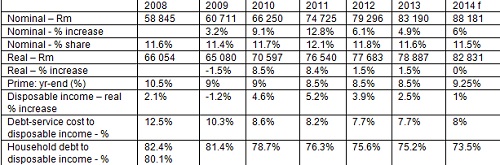
Source: Stats SA & SA Reserve Bank; CGIC analysis and forecast

