

Stagnant growth in Q1 prompted Singapore to switch to “Neutral Policy Stance”
After reducing the rate of appreciation of the policy band in January and October 2015, the Monetary Authority of Singapore (MAS) announced to set the rate of appreciation of the Singapore dollar nominal effective exchange rate (S$NEER) policy band at zero percent, beginning April 14, 2016.
The width of the policy band and the level at which it is centred will be unchanged. This came as a surprise to markets. Shifting from the usual policy stance of a modest and gradual appreciation that MAS had adopted since April 2010 to a neutral policy stance of zero percent appreciation, last used during the 2008-09 global financial crisis, is a bold monetary easing move.
There are three key reasons behind this, according to the MAS Monetary Policy Statement:
1) Weaker than expected economic growth: MAS said, “Compared to expectations in October 2015, the Singapore economy is now projected to expand at a more modest pace this year, against the backdrop of a less favourable external environment”. The less favourable external environment refers to (i) more modest expansion in the US economy amid weakening investment and exports, (ii) weakening economic activity in the Eurozone and Japan due to appreciating currencies and weak external demand, and (iii) moderate China’s growth momentum owing to the slow pace of economic reform and industrial overcapacity.”
2) More contained than expected inflation: MAS said, “MAS Core Inflation should also pick up more gradually over the course of 2016 than previously anticipated, and is now likely to fall below 2% on average over the medium term”. The more contained than expected inflation is probably due to (i) subdued imported inflation amid the
muted global inflation and soft international commodity prices, and (ii) moderating domestic cost pressures amid the slower wage growth and downtrend in car prices and housing rentals.
3) Zero percent S$NEER appreciation: MAS said, “The actual outcome of S$NEER movements over the six months since October 2015 has in fact been a zero percent appreciation compared to the preceding six-month period”. The Real Effective Exchange Rate (REER) index was quite steady. This situation did not translate into
higher inflation, while the economic growth prospect for 2016 would probably be poor. As a result, the move to a neutral policy stance seems necessary to boost the Singapore economy.
Risks
The MAS decision is a pre-emptive move to reduce the risk of a technical recession in 2016, after the release of the GDP advance estimates for Q1 which showed that on a quarter-on-quarter seasonally adjusted annualised basis the Singapore’s real GDP growth was zero in the first quarter of 2016, in contrast to an expansion of 6.2% in the
previous quarter.
On a year-on-year basis, the Singapore’s real GDP growth was stagnant at 1.8% in Q1, the same expansion as in the previous two quarters. The growth was supported by construction with growth quickening to +6.2% in Q1 (from +4.9% in Q4), while manufacturing activity declined at a slower pace of 2.0% in Q1 (from -6.7% in Q4). What is worrying is the services industry with growth decelerating to 1.9% in Q1, the
slowest since 2009Q3, (from 2.8% in Q4).
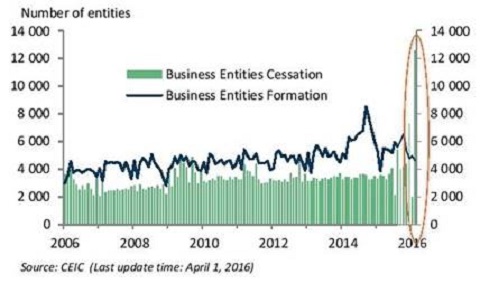
Besides, the outlook for business activity would probably be quite gloomy amid weak investment sentiment, as indicated by the graph below, showing that business cessation exceeded formation in a 3-month period from December 2015 to February 2016. This was mainly due to a significant increase in number of business cessation (closure of 8,247 entities) in the wholesale and retail trade industry. The last time for business cessation exceeding formation was in December 2009, during the post global financial crisis recovery.
The external sector in Singapore has been and will probably be clouded by the rather dim global trade outlook. Exports declined 3.0% on a year-on-year basis in February, the straight eleventh month decline, after plunging 15.1% in January.
All in all, the MAS move to the neutral policy stance will probably help reduce the Singaporean dollar appreciation pressure. The next possible move is likely to be some minor adjustments, for example, changing the level of the policy band which it would be centred.
Considering also the expansionary fiscal policy with a 7.5% increase in total expenditure in FY2016 over FY2015, Coface expects that the Singapore economy will grow 2% in 2016 (the mid-point of the MAS growth forecast range of 1% to 3%); but we believe that risk is likely tilted towards the downside, as the mounting global uncertainties might have more than expected adverse impact on the small and external oriented Singapore economy.

