

Projections for the steel industry
After the heady days of the 2000s, which were marked by the commodity boom and China's massive appetite as it became the largest producer and consumer, the steel sector is struggling. Eight years after the 2008 crisis, it is still suffering from significant overcapacity.
The structural slowdown in the Chinese economy is obviously one of the main reasons for this development, but other factors are also at work - including the contraction and tertiarisation of activity in the rest of the world. This includes the correlation of steel prices with other non-renewable commodities, which are also falling. Against this backdrop of sluggish demand, China’s steel production capacity increased from 660 million tonnes in 2008 to 1.12 billion in 2015.
The country is therefore flooding the rest of the world with its surplus steel, at the risk of causing bilateral tensions, as each country is concerned about protecting its national industries. Given listless domestic demand and foreign competition, financial problems are piling up for companies in this sector, which are among the most highly leveraged and least profitable in the world.
After the 2.2% fall in 2015, global steel production is expected to contract by a further 2.5% in 2016, according to Coface. The first reduction in Chinese production capacity (40 million tonnes in 2015) and the difficult situation encountered by steel manufacturers, are confirming this scenario.
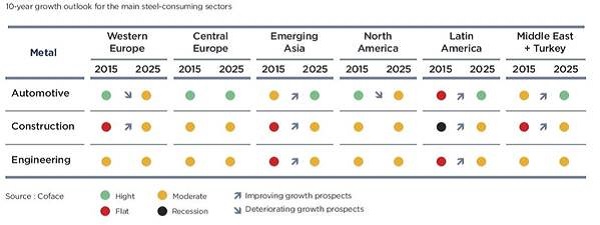
Steel demand is likely to remain sluggish in 2016 (0%), following a fall of 2.5% in 2015, due to the Chinese effect. But there are glimmers of hope in the longer term. Coface expects global demand to grow by 1% in 2017 and then by 2.5% on average over the following years, due to the positive outlook for urban population growth in emerging countries.
A readjustment in 2016, with a return to normal from 2018
Global steel demand therefore seems to be cyclical, but it is also under the heavy influence of China's structural economic transition. The country, the world’s largest steel consumer and producer, will nevertheless retain its leadership over the next decade. Demand for housing will continue to grow in China, driven by the needs of a new middle class to live in cities. India also appears to be a promising market, as its convergence is likely to accelerate in the next decade, bolstered by its dynamic demography.
Global steel consumption grew 6.7%, on average, between 2001 and 2007. In the same period, annual global growth was 4.4%. Potential global growth is likely to be lower between 2020 and 2025 (+3.5%), due to the slowdown in the Chinese economy towards a growth rate of 5.0%, versus 2.0% in the United States and 0.9% in the EU.
According to Coface, as mentioned, global steel production is expected to contract by 2.5% in 2016, following the 2.2% decline recorded in 2015. The first reduction in Chinese production capacity and the very difficult situation faced by steel manufacturers confirm this scenario. The market should therefore start to correct in 2016, be rebalanced in 2017 and return to normal from 2018. It should be able to create expectations of an increase in prices from 2017.

