

Euro area: Slow growth
Euro-area GDP growth slowed during the second quarter of 2015 at 0.3% Q-o-Q (against +0.4% for 1Q 2015), above the average quarterly growth rate for 2013-2014. Growth increased in Germany (+0.4% against +0.3%) and Spain (+1.0% against 0.9%), sustained by net exports and internal demand. On the contrary, French growth collapsed to 0.0% against +0.7%) with positive contribution of net exports compensated by a negative contribution of inventories.
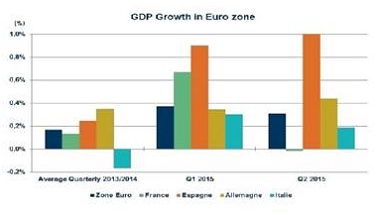
Growth remained sluggish in Italy (+0.2% against +0.3%), driven by internal demand. Performance in Greece was surprisingly positive (+0.8% against +0.0%), helped by deflation, but did not include the impact of the imposition of capital controls introduced at the end of June and the three week shutdown of banks, which should significantly hamper growth in the third quarter.
Temporary factors are sustaining Euro-area economies. Firstly, the low oil price is reducing energy bills as Euro-area countries are oil importers, and contributes to holding inflation down (0.2% in July, stable compared to June). Secondly, the depreciation of the euro against other currencies (the real exchange rate decreased by 12% between January 2014 and July 2015) is making Euro-area exports more competitive.
The fiscal policy seems broadly neutral compared to the past years and the monetary policy remains accommodative, with the low ECB interest rate (0.05%) and quantitative easing. Financial conditions improved; fragmentation in the Euro-area has been partially addressed (spreads on government debt narrowed and rates on corporate and bank bonds converged), reviving credit demand.
However, some imbalances persist and prevent growth from being more dynamic. The deleveraging process has already begun but is progressing slow. In Q1 2015, Eurozone household debt-to-income ratio reached 94% and the non-financial corporate ratio 135%, with significantly higher figures in Spain, Ireland and Portugal. Reducing the unemployment rate remains a challenge in many economies, especially in Spain (the unemployment rate was 22.5% in June).
Risks
Some downside risks and uncertainties are weighing on the recovery. Firstly, new financial tensions cannot be excluded. A new deterioration of the Greek situation could induce negative spillovers, even if they have been quite limited in recent weeks.
The slowdown in China could also have significant side effects, but this will depend on the nature of the slowdown. The annual growth target (7%) is at risk, as recent macro-economic indicators show and could weigh on Euro-area exports. Nevertheless, if the slowdown is accompanied by a rebalancing of Chinese economy towards internal demand, the impact on the Euro-area would then be neutral or positive.
In the long run, the authorities should take on the challenge to correct the remaining imbalances and increase potential growth. Further efforts are needed, notably through additional investment and the completion of the Single Market in order to raise economic activity and to make growth more inclusive.

