Brazil companies at high risk of payment default
Brazilian companies are currently faced with a challenging economic environment. GDP saw an accumulated contraction of 7.4% between 2015 and 2016 and credit condi¬tions deteriorated against a backdrop of more restrictive credit supply and a tighter monetary cycle. The GDP forecast for 2017 is lackluster at 0.4%.
The car-wash operation, the biggest and longest corruption investi¬gation ever carried out by the Federal Police of Brazil, has not only influenced the performance of major conglomerates involved in the scandal, but has impacted the activities of companies that rely on sales to the groups under investigation.
The bleak economic environment has overshadowed payment behaviour. Coface’s payment study has revealed that in 2015, 75% of the companies interviewed received requests for payment exten¬sions from their clients. The majority (58%) experienced an increase in their delinquency rates in 2015 com¬pared with 2014. In 2016 the delinquency rate was lower at 46%.
Payment experience by sector
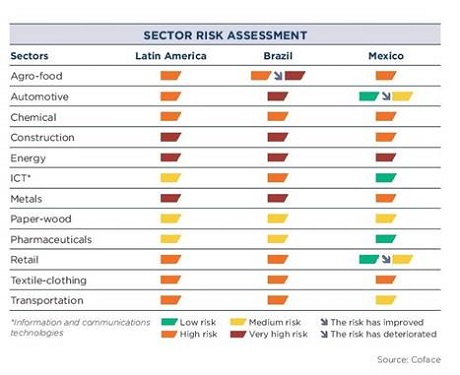
The bleak context of the Brazilian economy has clearly taken a serious toll on various sectors. Coface’s sector risk assessment does not currently classify any of the country’s segments as low risk. The paper-wood and pharmaceuticals segments (both at medium risk) have shown higher resilience than other sectors. In contrast, metals, energy, construction, automotive and agro-food are all classified at very high risk.
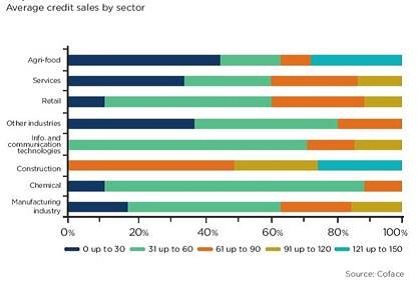
Average credit sale periods (see graph below) are divergent among the sectors, although in most segments they do not exceed 60 days. Only the construction and agri-food sectors granted credit periods of over 120 days. Interestingly, construction is the only sector which did not report sales periods of below 60 days.
In terms of payment behaviour by segment (see graph below), delays appear to be high in almost all industries. Information & communication technologies and construction are the most affected. All these companies (100%) report payment issues.
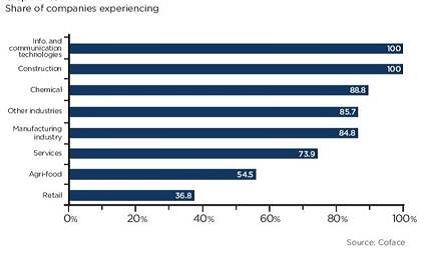
Surprisingly, the least affected is retail, at 36.8%. This is a some¬what unexpected due to the recent poor performance of retail (-6.5% in 2016) which is strongly influenced by weak income fundamentals (the unemployment rate stood at 11.5% in 2016 – a rise of + 3.1 percentage points in one year). However, it should be noted that Coface’s limited database may have influenced this result.
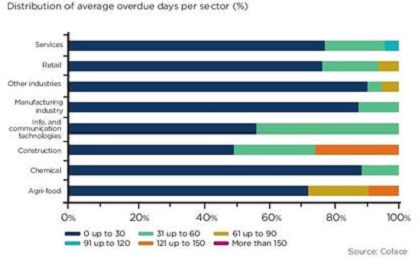
Average overdue days per sector (see graph below) are, for the most part, up to 30 days. The only segments which reported delays of over 120 days were construction and agri-food. Both these sectors work with relatively longer terms of payment as seen in a previous chart. It is also of interest to note that none of the cases in Coface’s sample exceeded 150 days.