

Argentina’s presidential election: Pro-business candidate has Won the runoff
After coming second in the first round of Argentina´s presidential election, the candidate Mauricio Macri from the political coalition Frente Cambiemos won the runoff. Macri received 51.4% of the valid votes and defeated Daniel Sacioli of the Peronist Frente para La Victoria, with President Cristina Kirchner’s endorsement.
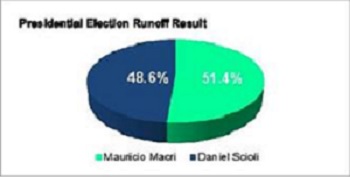
Despite the result achieved by Macri, the biggest challenge is yet to come. The new president, will take office on 10 December 2015 for a four-year mandate, will inherit an economy steeped in trouble. The Kirchner´s long incumbency, Cristina and her late husband´s Nestor, have run the country over the past 12 years, marked by populist and interventionist policies. Inflation has been running at over 20%, foreign exchange reserves remain shrinking and the legal impasse associated with the country´s foreign debt default in 2001 still hasn´t been solved.
An agreement with the default holdout should not come immediately. Over the years the Kirchner´s renegotiated a huge discount on the debt owed to 92% of the country’s creditors. A judge in the US gave a favourable ruling for bondholders in June 2014, but did not include the structured debt (the holdout funds). Since then other debt holders gained similar cases. The agreement is mandatory to regain access to international capital market.
However, the Argentine government would need to pay $8 billion (USD) (roughly 1.3 % of GDP) to the vulture funds. Argentina cannot afford this, as its international reserves stand at roughly $16 billion (USD) (discounting the $11 billion swaps with China). A new round of negotiations should start.
Macri pledged to remove exchange rate controls, ending the booming black currency market. This should be one of his first measures, as deteriorating trade balance increased the pressure over the devaluation of the Peso. In the last month the daily quota of dollars that can be released for Argentinean importers without Central Bank prior approval was reduced. It went from $150 000 (USD) to $75 000 (USD) and finally to $50 000 (USD) in just six days before the runoff.
The new president also supports a more free market. In the day after his victory he announced that the Mercosur should be reformed and he would seek closer ties with the Pacific Alliance and Europe. Export tariffs (very common for agro commodities) will also be removed in his first day in office. His first official trip will be to Brazil, Argentina’s main trading partner. However, trade flows considerably decreased over the past years due to the import barriers and recession in Brazil.
The shift in power in Argentina may further reduce the strength of other populist governments in the rest of South America. In his first press conference after elections, Macri said he will call for Venezuela´s suspension of the Mercosur, due to President Nicolas Maduro democratic abuses. Leftist governments have seen their approval rate sharply decreasing with the end of the commodity boom and after years of financial mismanagement.
Social welfare programmes will be maintained, the main concern of voters who backed Scioli. The Kirchner´s gained popularity with heavy spending on programmes for the poor, which caused a worsening of the fiscal balance and was financed by printing money, pressuring inflation. The fiscal deficit is close to 6% of GDP.

