

PFA sees a surge in new complaints after implementation of two-pot system
The Office of the Pension Funds Adjudicator saw a 13% increase in the number of new complaints during the 2024/5 financial year, with the implementation of the two-pot system being one of the reasons for the rise.
The two-pot system, which came into effect from 1 September 2024, enabled members of retirement funds to have access to money from their savings component without leaving employment.
Funds received a significant number of two-pot withdrawal applications from members. However, there were processing delays, as some funds underestimated the uptake, whist some could not pay the claims as employers owed arrear contributions. The OPFA received a total of 239 two-pot related complaints from September 2024 to March 2025 (excluding enquiries).
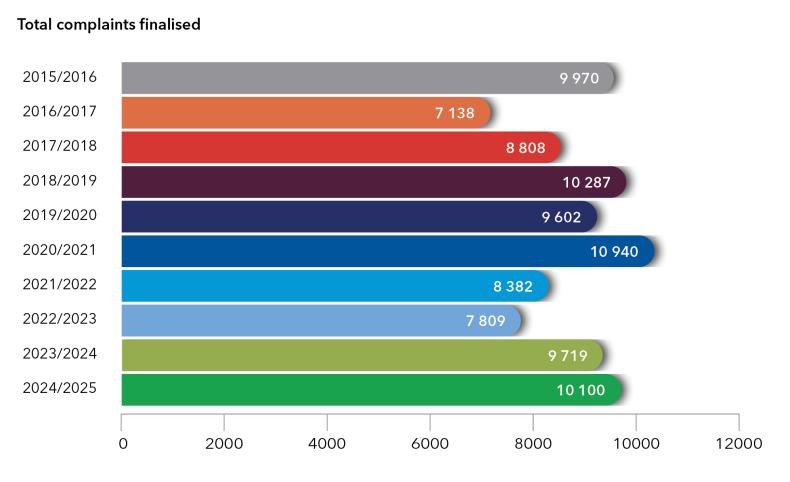
According to the 2024/5 Annual Report of the of the OPFA, the pensions dispute resolution forum received 10 331 new complaints (9177 in the previous year) and disposed of a total of 10 100.
TWO AREAS OF CONCERN
Non-compliance with Section 13A of the Act, whereby employers failed to pay over retirement fund contributions, remained a prevalent issue, making up 44.34% of all complaints investigated and closed. Complaints concerning withdrawal benefits constituted 38.79% of all complaints. Further, the two categories often overlapped, with a complainant only discovering that his or her employer failed to pay contributions at the stage of withdrawing their benefit.
Minister of Finance Enoch Godongwana said in a message to the annual report: “The recurrence of these issues and the high number of complaints remain of great concern, and stakeholders are urged to remediate this undesirable result of poor fund governance, management, and administration.
“This, in effect, undermines the government’s efforts as outlined in the three priorities of the Government of National Unity to reduce poverty, tackle the high cost of living, and build a capable, ethical, and developmental state,” he said.
The Private Security Sector Provident Fund (PSSPF) in particular also added to the surge in new complaints. Private security companies are obliged to participate in the PSSPF. Employers in the private security sector who deduct retirement fund contributions from their eligible employees’ salaries, are not able to manage their finances properly. Additionally, the PSSPF does not appear to have a proper monitoring system in place to detect non-payment of contributions by employers and has also consistently failed to act against defaulting employers.
The Financial Services Tribunal (FST) was established as a fee-free regulatory entity for
for aggrieved people that, amongst other functions, exists to reconsider the PFA’s determinations, at little to no cost relative to the expensive and lengthy formal court process. During the period under review, 87 applications for reconsideration were made by people aggrieved by the OPFA decisions. The FST issued 83 decisions and four applications were withdrawn. Of the 83 decisions, 54 were upheld, and 27 were remitted for reconsideration.
Muvhango Lukhaimane, the Pension Funds Adjudicator, said in the annual report:
“Through continuous evaluation, stakeholder feedback, and agile adaptation to legislative and industry changes, including the implementation of the two-pot retirement system, the OPFA remains steadfast in its commitment to justice, fairness, and quality service for all retirement fund members
“While the implementation of the two-pot system has been successful, a further rise in complaints related to two-pot withdrawals is anticipated in the 2025/26 financial year, prompting the OPFA to prioritise resource allocations and proactive stakeholder engagement.”
THE COFI BILL
Meanwhile, the Conduct of Financial Institutions (COFI) Bill is expected to significantly change the legislative environment of financial regulatory tribunals. COFI is part of the broader Twin Peaks regulatory reform, that aims to create a single, unified, and consistent legal framework for the market conduct of financial institutions.
Nondumiso Ntshangase, Senior Legal Advisor at the OPFA, said the impending COFI Bill may affect the mandate of the OPFA by expanding the definition of “complaint” to also introduce “advice”.
According to the Deputy Pension Funds Adjudicator, Naheem Essop, the expansion of the definition of a “complaint” to include not just disputes or grievances, but also issues arising from financial “advice” could empower the OPFA to investigate and adjudicate cases where poor or misleading advice has led to adverse outcomes for pension fund members - an area that previously may have fallen outside its jurisdiction.
Ntshangase said the COFI Bill also proposes the definition of “complaint” to include a requirement to accept oral complaints. She said this might create uncertainty as complaints might not be captured correctly, leading potential delays in finalising them. There will also be financial implications, as oral complaints will require independent transcription to ensure accuraty.
She said the COFI Bill will further expand the definition of “retirement fund” to include public sector retirement funds, thereby expanding the OPFA’s jurisdiction to address public sector fund complaints.
______________________________________________________________________________________________________________________________________________________
Lukhaimane signs off after 12 years of guarding against pension funds abuse

After 12 years of overseeing thousands of determinations that put back millions of rands into the hands of aggrieved retirement funds beneficiaries, Pension Funds Adjudicator Muvhango Lukhaimane will conclude a remarkable journey of service.
Lukhaimane took over as South Africa’s fifth Pension Funds Adjudicator on 1 July 2013 and developed the tribunal into a formidable dispute resolution body, renowned for its efficiency, impartiality, and jurisprudential integrity in adjudicating complex pension-related matters. She will leave the Office of the Pension Funds Adjudicator at the end of the year.
She served as Deputy Pension Funds Adjudicator since 1 June 2012, during which time she kept her promise to eliminate the backlog of complaints going as far back as 2007.
Possessed with a wealth of experience as a seasoned lawyer who had also been employed within the pension funds industry and public sector as a senior manager, she brought to her appointment as Pension Funds Adjudicator the skills acquired throughout her working life.
She obtained a B.Iuris degree from the University of Venda and LLB degree from the University of Pretoria. Through part-time studies she obtained the Master of Laws degree, with emphasis on human rights law, constitutional interpretation, labour law and medical jurisprudence. Ms Lukhaimane also obtained a Postgraduate Diploma in Financial Planning from the University of Free State and completed an MBA through Wits Business School.
During her tenure as Pension Funds Adjudicator, she worked hard at improving stakeholder interaction so that the dispute resolution forum became more visible to the public. She always maintained that pension funds played an important role in the national economy.
“Pension funds, smartly invested, provide a mechanism for unlocking savings, stimulating economic growth and ensuring that pensioners are provided for in retirement.
“By regulating them appropriately, the elderly can be protected against poverty, investment can be facilitated and systemic risk reduced, she said.
Lukhaimane said she was leaving as Pension Funds Adjudicator with immense gratitude and pride in what the office has been able to achieve, from good governance to efficient, timeous service delivery.
“It has been an extra-ordinary privilege to serve in this role - championing fairness, promoting accountability, and striving to protect the rights and dignity of retirement fund members. Over the years, I have witnessed the retirement fund system evolve and I have had the honour of being in the midst of implementing key legislative reforms. I am encouraged by the collective progress we have made and appreciate that there is still more to be done.
“I wish to take this opportunity to thank the dedicated teams I have had the privilege of working with, the various stakeholders who supported our mandate, and the public who entrusted us with their queries.
“As I step off at my station, I remain confident in the capacity, integrity, and the continued role of the office in protecting consumers,” said Lukhaimane.


