

Life Ombud - Ombuzz - Compensation
Irrespective of the outcome of a complaint on its merits, our office can award compensation for inconvenience, distress or financial loss caused by an insurer's mistake or poor service.
In terms of our Rule 3.2.5 we can make a determination to:
"award compensation, irrespective of a determination made in terms of Rule 3.2.2 or 3.2.3, for material inconvenience or distress or for financial loss suffered by a complainant as a result of error, omission or maladministration (including manifestly unacceptable or incompetent service) on the part of the subscribing member; provided that the amount of such compensation shall not exceed the sum of R30 000 or such other sum as the Long-Term Insurance Ombudsman's Council (“the Council") may from time to time determine;"
There are cases on our website regarding compensation and the following 2 cases demonstrate our approach when we have to decide on compensation issues.
Case 1
Facts
It was common cause that the complainant suffered from a benign tumour of the pituitary gland. The complainant's illness was of a serious nature and her neurosurgeon said the following about it:
"Therefore they are dread and severe illnesses, and what this patient underwent was major brain surgery to rid herself (successfully) of the pituitary tumour, followed by radiation to the brain, to make sure the tumour never returned".
The claim form was completed by the same doctor who "ticked" a space marked "benign brain tumour" and who wrote the following next to it: "Benign pituitary macroadenoma fully removed".
The policy specifically excluded cover in relation to "benign tumours of the pituitary gland".
The complaint is set out as follows by the complainant:
"My issues are leaning more towards the fact that (the insurer) made me spend more money and time in finding all the secondary documentations that they requested to assess the validity of my claim, only to be told that my condition is not severe enough, and is not covered by their company's policy so they will not pay my claim.
In their argument not to pay out my policy (the insurer) states that their policy does not cover the tumour of the pituitary gland. Surely if that is the case, there is no need for their clients with ill-health to be sent around to collect all history of the medical records dating as far back as 5 years. This information was requested after the forms and loads of other forms were sent to (the insurer), and to involve assessors to evaluate the claim and so on. The claim (could) have been stopped from the first line agents before passed on to the assessors. To make the matters worse, the assessors whose job is to assess the validity of the claim against the so- called policies knew nothing about the policies but requested more information which required me to go back as far as 5 years collecting medical history records from various doctors. I should have used the time and money travelling across towns towards my healing and medical bills. I have paid my money to get the doctors to complete the (the insurer's) forms and release the information that was requested by the assessors. After all that trouble (the insurer) informs me that my illness is not covered by their policies. I doubt if I would be complaining if (the insurer) informed me from the onset that they don't cover benign brain tumours of pituitary gland".
The insurer initially defended its stance, saying it "reserves the right to investigate the validity of all early claims in order to ensure that only valid claims are paid". The complainant correctly pointed out that this response did not "address" her concerns. Our office suggested to the insurer that "there was no chance that this claim would be paid at all, so why was it necessary to look at (the complainant's) medical history at all?" We also informed the insurer that the complainant had "incurred expenses by having to go and collect the medical reports" and that she had been inconvenienced. We posed the question why compensation should not be awarded to the complainant. The insurer responded by saying that its "approach with regard to claims is on the agenda to be reviewed". At the same time it made an offer of compensation of R2 500,00, but no apology was offered to the complainant. The complainant rejected this offer and, in effect, made a counter-proposal that the insurer should pay her the amount of the policy benefit by way of compensation.
Discussion
The matter was considered at a compensation meeting and a provisional ruling was made that R5 000,00 compensation should be paid to the complainant. The insurer accepted this ruling, but the complainant rejected it and claimed the following amounts:
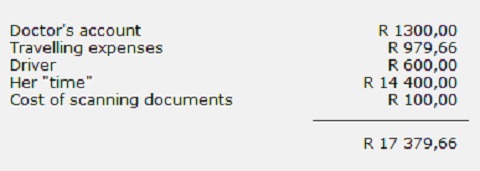
For "emotional and physical distress" the complainant claimed an amount between R500 000,00 and R1 000 000,00.
It was pointed out to the complainant that the maximum amount of compensation which may be awarded in terms of Rule 3.2.5 is R30 000,00. The complainant was requested to submit proof of the expenses which she had incurred in order to comply with the insurer's request for medical information. The complainant submitted the doctor's account for R1 300,00 and explained how the R100,00 "for scanning" was made up.
The documents which the complainant had submitted to substantiate her claim were sent to the insurer for its comments. The insurer agreed to also pay the doctor's account and R200,00 for "sundry expenses". The insurer undertook to pay compensation of R6 500,00 and said that this was "offered as a final settlement". The complainant responded by saying that the aggregate of R6 500,00 compensation "was still not acceptable".
The issue of the amount of compensation was again considered by the office and the complainant was advised that it considered the amount of R6 500,00 as being fair.
Result
The complainant "reluctantly" accepted the compensation offered, which the insurer paid.
Case 2
Facts
The complainant was diagnosed with cancer, for which she would have had cover, but for the lapse of her policy. After numerous telephonic requests by the complainant, the insurer sent a claim form to her, with a request to submit the hospital account. The complainant sent the claim form to the insurer, but received no acknowledgement thereof, nor any response to her telephonic enquiries. The complainant then wrote to the insurer and said "please, please, please be so kind as to 'phone me back ..." The insurer responded by writing to the complainant, saying that it needed a "copy of the histology (laboratory) report confirming the diagnosis of cancer... in order for us to proceed with your claim". To comply with this request, the complainant had to make 2 trips by taxi to the hospital. The cost involved was R200,00. The doctor charged her R150,00 for the report. The complainant had to obtain the report during office hours and had to "make up the hours", which she found very exhausting. On 11 April 2013 the complainant lodged the claim form with the insurer. By 10 July 2013 the insurer had not responded and the complainant wrote to the insurer to enquire about the claim. The insurer failed to respond and on 17 October 2013 the complainant again wrote to the insurer, enquiring about the matter. During November 2013 the complainant was telephonically advised that her policy had lapsed, but that the matter would be taken up with the insurer's "board". The complainant was promised that a form would be sent to her, which she would have to sign – it was conveyed to the complainant that she would be paid. On 6 and 10 January 2014 the complainant wrote to the insurer, enquiring about the claim and reminding the insurer about its promise. On 17 February 2014 the insurer repudiated the claim. On the strength of the insurer's letter, with the request for the medical report, the complainant believed that her claim would be paid and obtained a loan at a punitive interest rate. The complainant lodged a complaint to the office, pointing out that she had been put to trouble and expense as a result of the insurer's requests. Understandably, she questioned why she had not been told, in the first instance that the policy had lapsed. We took the matter up with the insurer, which apologised to the complainant and conceded that "the claim should have been rejected from the outset". The insurer said that it would pay the complainant's "cost for obtaining the medical reports", for which it needed invoices. The complainant later said that she did not have invoices for the taxi costs. The insurer refunded the doctor's fee, but declined to pay the claimant's travelling expenses. With regard to the travelling expenses, the insurer said that it is "only able to reimburse actual receipts provided and cannot make payment of non-receipts as this is an audit requirement". The insurer failed to provide any explanation for the way in which it had handled the claim, save to say that "during an audit of the file in 2013, it was "discovered" that the policy had lapsed.
Discussion
Given the insurer's attitude to the complaint it is perhaps not surprising that there was no offer by it for the payment of compensation to the complainant in terms of Rule 3.2.5. It is clear that the insurer sent the unfortunate "complainant on a stressful, wasteful exercise in futility – a veritable wild goose chase". This is what the office found in its ruling on the issue of the insurer's liability to pay compensation to the complainant and on the amount thereof. In the ruling this was also said:
"The above summary of the relevant facts speaks for itself and it demonstrates the material inconvenience and distress which the complainant suffered as a result of the insurer's manifestly unacceptable and incompetent service.
This office often emphasises the fact that no determination by it creates a precedent. Each case depends on its own facts and this is even more so when we make a subjective value judgment with regard to the award of compensation. Having said that, the attention is drawn to a similar matter in which our office recently gave consideration to the amount of compensation. The insurer involved in that matter should, at the outset, have realised that the insured's claim could not succeed, but it required a medical report from her, which was obtained at considerable cost and inconvenience."
When the office drew the attention of the insurer to the futility of its requirement, an apology and compensation of R1 000,00 were tendered.
The office was of the view that the complainant "deserves at least the same amount of compensation" as that which had been awarded in the other matter (Case 1), in which the compensation amount, excluding expenses, was R5 000,00. The office also accepted that the complainant had reasonably incurred travelling expenses of R200,00 in order to comply with the insurer's request.
A provisional ruling was made, awarding the complainant compensation of R5 200,00.
Result
The complainant accepted the ruling and wrote a letter of thanks to the office. The insurer paid the amount without demur.

