

Swiss Re's 2017 SONAR report examines top emerging risks the re/insurance industry and society are facing
• Swiss Re's latest SONAR report features 20 new emerging risk themes and six emerging trend spotlights the re/insurance industry should have on its radar • Reduced market access, regulatory fragmentation, the return of inflation, and cloud risk accumulation pose the largest challenges with the highest downside risk potential in the short term • Other risks further out on the time scale are in the health and environmental area, such as the potency of underestimated infectious diseases and growing water stress • The yearly SONAR report aims to spark an informed dialogue about what future risk landscape might lie ahead
Reduced market access, regulatory fragmentation, the return of inflation, cloud risk accumulation, but also emerging liability legislation for artificial intelligence, are some of the key risks identified in this year's SONAR report published today. The publication is based on the SONAR process, a crowdsourcing tool drawing on Swiss Re's unique internal risk management expertise to pick up early signals of what lies beyond the horizon.
The report offers insights into emerging risks and highlights a number of emerging trend spotlights. Emerging risks are newly developing or evolving risks that are difficult to quantify and sometimes not fully understood, but potentially have an impact on the industry and society. Emerging trend spotlights examine early development, which may offer both opportunities and risks for the insurance industry in the future. The report is widely distributed among clients and the wider stakeholder community in order to inform the debate about emerging risks and facilitate the finding of solutions.
"Ignoring emerging risks is not an option, neither for political decision-makers, the insurance industry, nor society as a whole. The earlier we adapt to these changes, the better prepared we will be", says Patrick Raaflaub, Swiss Re's Group Chief Risk Officer. "Sharing knowledge through a proactive risk dialogue across stakeholders can help the insurance industry create a pro- active and pre-emptive risk management culture that enables disciplined risk- taking. That is an important step to help society as a whole to become more resilient". Raaflaub adds.
The identified risks are relevant to life and non-life insurance areas as well as asset management. They are presented with the goal of helping industry players prepare for new scenarios by adapting their behaviour, market conduct and product portfolios.
Table: Overview of the 20 new emerging risks and their potential impact over time
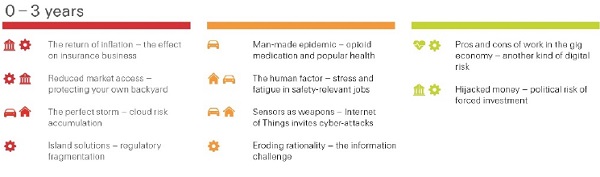
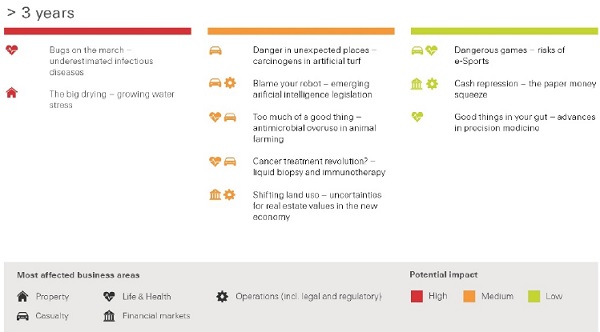
The six top risks with the highest potential impact:
Reduced market access – protecting your own backyard: The use of regulation to control capital flows and encourage protectionism could eventually undermine the business models of international corporations.
Island solutions – regulatory fragmentation: Increased fragmentation in regulation could undermine re/insurers' ability to support economic activity and act as stabilizers in the financial markets. In a fragmented regulatory world there is also much less opportunity to efficiently pool risks.
The return of inflation – the effect on insurance business: After years of low inflation and even fears of deflation, we see signs of headline price increases here and there. Inflation can affect insurers' profitability, in particular on long-term liabilities (life, casualty). It can also have an adverse impact on asset management.
The perfect storm – cloud risk accumulation: Cloud services have become widespread, for business and households alike. But as the cloud accumulates data-sets and services on an ever-increasing scale, it also generates a variety of risks that may accumulate to a "perfect storm", e.g. by a cyber-attack or a power blackout.
The big drying – growing water stress: While the U.S. Southwest is in an on-going water crisis, similar situations can be found today and in the future around the world – from Southern Europe and the Mediterranean to Africa, parts of Asia and Latin America. The risks range from wildfires, competition for water among the energy and agricultural sectors to mass migration and wider conflict potentials.
Bugs on the march – underestimated infectious diseases: The question is not whether deadly infectious diseases will appear, but when and how society is prepared to cope with them. In an extreme scenario, each epidemic or pandemic has high relevance for life and health insurance and the financial markets.

