

Bryte SA Crime Tracker: March 2017

Cloud Saungweme, Chief Claims Officer at Bryte Insurance.
• Moderation in annual growth of theft • Contact crime continuing to contract • Security tip: get involved in community policing
Bryte Insurance, a proactive business risk specialist, today released its March 2017 Crime Tracker; an indicator of long-term crime trends in South Africa as captured by insurance claims. The Crime Tracker measures the annual change, on a monthly basis, in crime-related claims due to hijacking, robbery, theft and malicious damage, committed against individuals and businesses.
Crime trends in March 2017
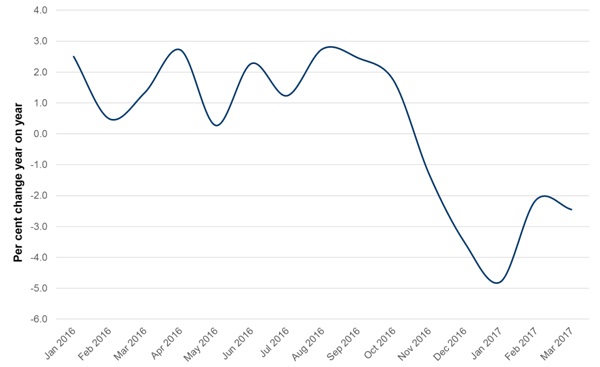
The Bryte Crime Tracker reflected a 2.5% contraction in March 2017 when compared to the same month in 2016. The Theft category decelerated to a 1.5% annual growth in March 2017 from 3.8% in February 2017. Growth in total crimes against individuals decelerated to a 2.3% annual growth rate in March 2017 from 9.4% in February 2017, while growth in total crimes against businesses contracted annually by 5.4% in March 2017, from the 9.9% contraction in February 2017.
“We need to take theft seriously, as most criminals start off by stealing small items such as mobile phones, but unfortunately ‘graduate’ to become violent criminals who eventually become part of organised crime syndicates,” said Cloud Saungweme, Chief Claims Officer at Bryte Insurance.
Graph 1: The Bryte Crime Tracker

Contact crime, malicious damage and theft
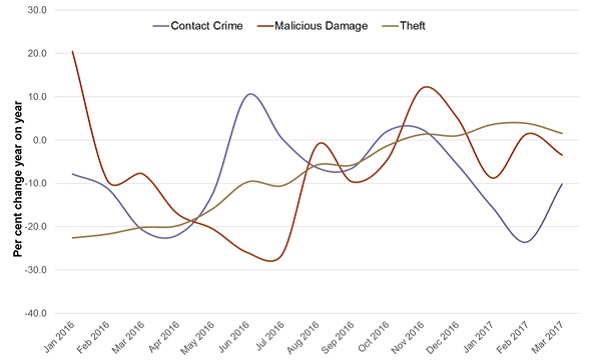
The Bryte Crime Tracker for Contact Crime (robbery and hijacking) contracted by 10.2% on an annual basis in March 2017 from a 23.5% contraction in February 2017. Malicious Damage (to fixed and movable assets) contracted by 2.4% in March 2017 from an annual growth rate of 1.4% in February 2017. Theft moderated to a 1.5% growth rate on an annual basis in March 2017, from the temporary peak of 3.8% growth in February 2017. This is the fourth consecutive month that has recorded annual growth in the Theft category.
Graph 2: Contact crime, malicious damage and theft

A recent Statistics South Africa report Exploring the extent of, and circumstances surrounding, housebreaking/burglary and home robbery, showed that the general crime rate (in terms of the proportion of households that experience crime) has been declining over the last five years. This reality, however, has not quelled the growing perception that crime is on the increase in South Africa. Over 50% of all crimes experienced by households in South Africa in 2015/16 were house break-ins followed by home robbery (11.9%).
“While we see a decrease in violent crimes, the emotional trauma is so severe and the fear instilled in community members so intense, that we also see a general increase in security upgrades in homes and work properties. The problem is that many people view crime as a problem that the authorities need to address, as opposed to becoming part of a community policing forum (CPF). The police cannot fight crime on their own,” continued Saungweme.
As a security tip, he recommends that individuals contact their local CPF (affiliated to the police station in the area). A CPF is the only recognised consultative forum designed to permit communities to raise concerns with police and allow police to inform members about potential risks. The CPF is therefore an important vehicle for two-way communication between the police and community, and seeks to promote cooperation, transparency and accountability amongst law enforcement. By law, a CPF has an oversight role to play and is not merely a post-box for complaints.

